
Pasolini Co-Lab
The purpose of the CoLabs in the 4P project was to provide skill-building opportunities for young people in the cultural and creative industries sector, aiming to foster the revitalization of blighted areas. The case study chosen for the project was Kajzer Park in Idrija, the main site of the location inscribed on the World Heritage List as a mercury extraction facility, which has been abandoned and in an advanced state of decay for several years. Within the park, there is also an unlisted building that has been identified as the residence of Pier Paolo Pasolini during his year-long stay in Idrija in the early 1930s. Today, this building is in a state of disrepair, but it holds clear potential to serve the reuse of the park itself.
The CoLabs described in this report refer to two workshops conducted by the University of Nova Gorica (Cultural Heritage Studies unit, supported by the Faculty of Humanities and the Academy of Arts) together with local partners in Idrija, namely the Municipality and the ICRA Development Agency. The two workshops took place during the week of April 13–17, 2026, in Idrija. They were structured differently because the first was aimed at local grammar school (ginnasio) students, while the second targeted international students with basic background in cultural and creative industries and diverse applied experiences.
1. First CoLab: Workshop on the Interpretation of Cultural Heritage (April 13, 2026)
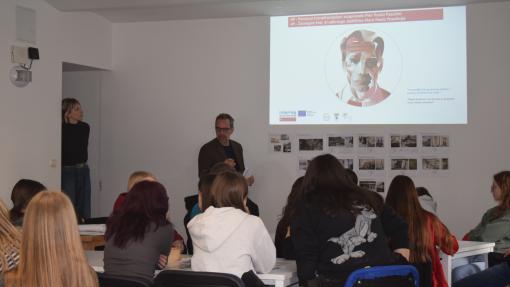
For Idrija, the enhancement of cultural heritage represents a challenge and an opportunity to be shared with younger generations. A small town inscribed on the World Heritage List with exceptional cultural heritage needs to engage with the youth, who require stimulation to develop awareness regarding the historical and social context in which they grow up. From this perspective—also supported by the Municipality of Idrija and the local development agency ICRA, who insisted on focusing on younger generations through intergenerational dialogue—the first workshop involved secondary school students, inviting them to reflect on the identity of the place through the concrete example of Kajzer Park and the house that hosted Pier Paolo Pasolini.
The objective was twofold: on the one hand, to foster critical awareness of what constitutes heritage (both tangible and intangible), and on the other, to stimulate active participation in reading, interpreting, and imagining potential new uses for historical spaces. Furthermore, selecting a group of secondary school students (the primary school could not be involved due to academic scheduling) also served to build a temporal parallel with Pier Paolo Pasolini, who lived in Idrija at the age of 9–10.
The experience began with a solid theoretical introduction to the various aspects of cultural heritage as established by doctrine and international debate, including historical, artistic, educational, economic, and emotional values, as well as the concepts of authenticity and integrity.
Following this introduction, the students—divided into groups—worked with photographs, site plans, and historical accounts, practicing the analysis of the authenticity and integrity of the sites. This process led them to discuss which elements to retain, modify, or rethink, and to debate the very meaning of heritage in relation to generations and time. The most relevant insight that emerged from the students' group work and discussions was the clear need to engage directly with space and landscape: working on recognizing items and enhancing their value by observing details, reflecting on core values, and imagining transformations aimed at revitalizing these sites. Another important aspect was the opportunity to introduce Pasolini to the youth, allowing them to perceive a figure previously unknown to them—yet demonstrably significant—from a different angle: that of the aura he left behind and our present-day responsibility to protect it in all its powerful evanescence.
The workshop proved to be a valuable opportunity to introduce critical skills into the education of new generations, presenting concepts related to heritage protection and enhancement in a format different from what is currently available in school curricula. Moreover, it clearly contributed to raising awareness about the importance of Kajzer Park (many students were unfamiliar with it and had never seen it, as they lived in surrounding hamlets rather than the town center of Idrija) and Pasolini’s house, leading them to be perceived not just as sites to preserve, but as instruments for intergenerational education.
Key Concepts Addressed
Understanding cultural heritage is essential for appreciating not only our past, but also the ways in which it actively shapes our present and future. At its core, cultural heritage represents the collective memory and territorial identity of communities, expressed through both tangible and intangible forms. Tangible cultural heritage includes monuments, buildings, sites, and landscapes, such as Idrija's remarkable mining heritage, which is recognized on the UNESCO World Heritage List. These physical traces of human endeavor remind us of the ingenuity, craftsmanship, and artistry of previous generations. At the same time, intangible cultural heritage—encompassing traditions, performances, rituals, knowledge, and skills—ensures that values, languages, and community bonds are transmitted onward, as seen in practices like Idrija's famous bobbin lace-making or traditional Slovenian beekeeping.
Authenticity and integrity are essential to understanding heritage value. Authenticity concerns the credibility of traditions and objects, ensuring that what we preserve and pass down is true to its origins. Integrity refers to the wholeness of a heritage site or practice, preserving it as a complete, functional, and meaningful unit. However, cultural heritage values extend far beyond history or aesthetics. Heritage possesses a comprehensive value system: it provides economic, social, scientific, emotional, and spiritual benefits. For instance, Idrija’s historic mercury mine is not merely a monument to industrial heritage; it is also a catalyst for education, tourism, research, and creative innovation. The preservation and adaptive reuse of heritage sites—such as converting old mills, armories, or traditional houses—require diverse skills, ranging from engineers and architects to historians, artists, and craftspeople.
The discussion on values focused primarily on how economists have recognized numerous impacts of cultural heritage: some obvious to all (such as artistic or historical components), and others far less known yet crucial to enriching that same heritage. The use and non-use of heritage, as well as components comprising cultural value—which is determined by a dense collection of macro and micro values linked to individuals, organizations, eras, communities, etc.—are specifically included here as elements of economic value. Examining Kajzer Park and Pasolini's house reveals, for example, that Pasolini's historical presence in the industrial complex adds new layers of value, providing significant cues that increase the overall value of the site.
This naturally leads to the concept of Cultural and Creative Industries (CCIs). CCIs represent a dynamic sector where heritage inspires and generates new forms of creativity and employment—far beyond tourism alone. Restoration projects, design, cinema, performing arts, digital content, and many other creative fields are rooted in the skills, stories, and values inherited from the past. In Idrija, CCI activities are helping to revitalize the town, create jobs, and connect local traditions with global audiences.
The work on the building that hosted Pasolini—as a spatial experience and an exploration of the concepts of authenticity, integrity, and heritage values—was introduced through a structural description of the building itself, which students also received as printed material. (Some of the presented images are omitted here).
In conclusion, preserving cultural heritage is not a passive act; it is a driver for sustainable development, innovation, and social cohesion. It enriches our lives, creates opportunities across various sectors, and ensures that the unique stories of places like Idrija continue to inspire future generations. As high school students and future professionals, recognizing the diversity and depth of heritage values empowers you to become both its guardians and innovators in virtually any field or profession.
2. Second CoLab: Workshop on the Future of Kajzer Park as a Social and Creative Space (April 17, 2026)
The second workshop brought together international university students from Slovenia, Italy, Serbia, North Macedonia, Greece, Portugal, Latvia, and Turkey, alongside professionals, community representatives, and local stakeholders. They were invited to explore the potential of Cultural and Creative Industries (CCIs) as a driver for employment and spatial/territorial regeneration. The objective of the workshop was to define innovative strategies for the reuse of Kajzer Park and Pier Paolo Pasolini’s house, connecting historical heritage to the present and future of Idrija.
The workshop followed the agenda below:
| Time (min) | Activity / Module |
|---|---|
| 11:00 – 12:00 | Welcome to participants by UNG, ICRA, and the Municipality of Idrija, followed by a traditional local lunch. Subsequently, a walk to Kajzer Park. |
| 12:15 – 12:45 | Introduction and framing: introductory greetings, presentation of workshop objectives, and an introduction to the Cultural and Creative Industries (CCI) framework. |
| 12:45 – 13:45 | Visit to Kajzer Park and introduction to its main features. Presentation of the site's history, Pasolini’s house, and the planned revitalization of the area. The visit includes a short experiential site-reading approach based on movement, focus, and shared impressions, ensuring the subsequent vision-building work stems from a direct, situated experience of the location. |
| 13:45 – 14:30 | First workshop on the opportunities offered by Cultural and Creative Industries for Kajzer Park and its transformation. |
| 14:30 – 15:30 | Presentation of the cultural landscape, non-governmental organizations, and the artistic/architectural/design/craft sector of the Idrija and Cerklje region, presented by Matevž Štravs from ID20. |
| 15:30 – 16:30 | Group vision formulation – The park as a CCI hub (Part 1): Participants split into small groups to develop ideas for reusing the park's outdoor spaces and surrounding areas, focusing on accessible, community-driven activities.
Reimagining Pasolini’s house (Part 2): Groups continue by developing a detailed concept for reusing Pasolini’s house, transforming it into a vibrant cultural and creative hub.
|
| 16:30 – 17:30 | From ideas to actions – Annual event calendar: Groups draft an annual calendar of events that could be hosted in Kajzer Park, ensuring a balance of cultural, educational, and community-oriented activities. |
| 17:30 – 18:00 | Next steps and conclusions: Each group briefly presents its main ideas. This is followed by a joint discussion on how to proceed, identify potential partners, and secure initial funding. Workshop conclusion. |
| 18:00 – 18:30 | Return walk along the Pasolini Trail toward the cinema. |
| 19:00 – 20:30 | Screening of the film AMANDO MIO – Passione di un artista by Matjaž Mrak and Robi Šabec at the Idrija cinema, a outcome originating from the first CoLab. |
The workshop combined experiential visits, formal presentations from local stakeholders, and co-design tables. Following a guided tour and a presentation on the site's historical value and the prospects offered by CCIs, participants were divided into groups to develop concrete project proposals. The stated goal was to envision the park as a flexible space—a sort of incubator—with Pasolini’s house serving as the initial catalyst for transformation.
Among the proposals, a key highlight was the transformation of Pasolini’s house into a multifunctional Kulturhaus (a cultural house, guest house, artist residency, and center for events and commercial activities). The park itself was envisioned as a dynamic space animated year-round by festivals, markets, workshops, exhibitions, music events, and performances—all closely connected to Idrija’s mining and crafting traditions and the figure of Pasolini.
Additionally, an action plan for the park was drafted. The outlined action plan follows a progressive three-phase rollout:
- Phase 1: Launch with pilot events and short residencies, reactivating Pasolini’s house as a guest facility and gathering place for locals and visitors.
- Phase 2: Development of seasonal programming and workshops, including summer work camps focused on restoring the park and its structures using disused spaces.
- Phase 3: Institutionalization of a stable management and governance structure actively involving the local community and cultural stakeholders.
Special attention was given to youth inclusion, contemporary media/languages, and the economic and social sustainability of the initiatives. This relies on valuing local skills, producing innovative content, and building collaborative networks. The role of CCIs is decisive in ensuring project vitality and resilience: collaboration between local artists, craftspeople, and creatives, promoting events that engage with local history, and openness to experimental formats serve as cornerstones for a management model capable of adapting over time. Pasolini—with his multifaceted nature and ability to inspire new narratives—becomes the symbolic core around which an inclusive creative community is built.
Key Concepts Addressed
The UNESCO reference materials used for the workshop define cultural industries as sectors that combine the creation, production, and commercialization of goods and services whose defining feature is the intangible nature of their cultural content (generally protected by copyright). They also distinguish cultural services as intangible activities that respond to cultural needs or ideas and support cultural initiatives, whether provided by public institutions, foundations, private organizations, or hybrid structures.
For Kajzer Park, this distinction is crucial. The site should not be planned merely as a public cultural venue, nor solely as a creative business incubator. The workshop materials suggest that both dimensions are necessary:
- Cultural services: Interpretation, education, community access, guided programs, and heritage mediation.
- Cultural industry activities: Residencies, crafts, exhibitions, design, audiovisual production, publishing, festivals, markets, and new media formats.
This hybrid model aligns with the workshop’s goal: interpreting Pasolini’s presence in Idrija through contemporary cultural production rather than static commemoration. It also connects the site to the broader issue of how former industrial and heritage spaces can become active cultural infrastructure. Specifically:
- What are CCIs? Cultural and Creative Industries are economic sectors that produce and distribute goods and services based on culture, art, and heritage. They combine creativity with entrepreneurship, generating employment, wealth, and cultural value. According to UNESCO, they leverage creativity, knowledge, and intellectual property to generate cultural, economic, and social value.
- Main CCI sectors include: Cultural heritage (museums, historic sites), visual arts and crafts (painting, sculpture, lace-making, ceramics), performing arts (music, theater, dance), publishing (books, magazines), audiovisual and multimedia (cinema, television, video games, digital art), and design/creative services (fashion, graphic design, architecture).
- Why CCIs for regeneration? CCIs are recognized as effective drivers of urban revitalization. For a site like Kajzer Park, they can help transform a disused former mining area into a creative hub that promotes active participation and community social life, as envisioned by the local working group. This approach also aligns with the values of the EU’s New European Bauhaus (sustainability, inclusion, and aesthetics).
- Examples of existing urban and peri-urban cultural hubs: Basis (
https://basis.space/en/ https://base.milano.it/en/ https://dezwijger.nl/ https://www.104.fr/en/ https://luma.org/en/arles/the-parc-des-ateliers
Naturally, the spatial and historical features of the park were addressed in greater detail, enriched by contributions from local actors such as ID20—an association well known and awarded in Slovenia for its participatory heritage work.
- History: Kajzer Park is a former mining complex that formed one of the three main entrances to the Idrija mercury mine.
- UNESCO Status: Since 2012, it has been part of the UNESCO World Heritage Site Heritage of Mercury. Almadén and Idrija.
- Current Situation: The land surrounding the buildings suffers from soil contamination, and the forest-surrounded town of Idrija has very few public green spaces in its urban center. The Municipality is actively working on the area's revitalization and has secured funding from the Ministry of Culture and the Alpine Town of the Year program. A working group drafted guidelines to transform the site into a center for creativity and active participation for residents and surrounding communities. Existing activities already include occasional concerts, art installations, and student workshops.
- Who Pasolini was & the connection to Idrija: In October 1930, a young Pier Paolo Pasolini (1922–1975)—the famous Italian poet, writer, and film director—moved to Idrija with his family for a school year, attending the fourth grade in town. To commemorate his stay, Idrija participates in the European Interreg 4P project, which includes creating a circular thematic route through the town featuring his residence and a bathing area on the Idrijca River. This house can become an important cultural landmark.
Outcomes: From Ideas and Proposals for Future Management to the Role of CCIs
The central idea emerging from the workshops concerns transforming Pasolini's house and Kajzer Park into a full-fledged Cultural House in the broadest sense (inspired by Pasolini's versatile persona)—a permanent, creative Kulturhaus. This space would serve a multifaceted function, acting simultaneously as a guest house and residency for artists, students, and researchers, as well as a location for exhibitions, workshops, and public events. In parallel, the house would function as an interpretation and storytelling center for local heritage, connecting industrial memory with contemporary creativity and the broader Idrija community.
A fundamental aspect of this model is its annual programming, designed to alternate different types of activities to keep the park active year-round. Proposals include short residencies for young artists and creatives, summer camps, and workshops focused on restoration, crafts, and design, alongside markets and fairs featuring local products. These are complemented by seasonal themed events, such as music festivals, film screenings, poetry workshops, photography exhibitions, and outdoor theater performances. Particular attention is devoted to spaces designed to foster youth social life and intergenerational interaction, featuring green areas, yoga spaces, evening gatherings, clubs, and themed pubs.
Connecting with Cultural and Creative Industries is considered essential for ensuring both the cultural and economic sustainability of the project. The enhancement of local crafts and knowledge takes place through workshops and markets, while collaboration among artists, residents, and local craftspeople contributes to a rich, locally rooted cultural output. A thriving production of audiovisual, digital, editorial, and performance content is envisioned, drawing inspiration from both Pasolini's history and Idrija's heritage.
Significant emphasis is placed on youth and experimental expressions—ranging from punk and alternative music to rave events and underground film festivals—always respecting safety rules and harmonious co-existence among all participants.
The figure of Pasolini represents a heritage asset capable of inspiring new activities and narratives. His experience in Idrija is taken as a catalyst for further creative and educational practices. Dedicated events are envisioned, such as film festivals screening his works, poetry and literature series, and writing and journalism workshops. Thematic residencies will accommodate young artists and scholars interested in themes close to Pasolini—such as marginality, language, landscape, identity, and intercultural dialogue. Storytelling initiatives will take shape through literary walks, sound installations, and interactive exhibitions where Pasolini’s memory intertwines with that of Idrija's miners.
Educational activities aimed at schools will also feature prominently, offering tracks in cinema, theater, and journalism that bring together experts, professionals, students, and the community. Finally, the spaces will remain open to experimentation and non-conventional expressions, such as alternative music, performance art, and liminal arts, framed by constructive dialogue with the local community and an emphasis on safety and inclusivity.
The Meaning of Such an Initiative
The Pasolini Co-Lab initiative is rooted in the desire to use Idrija’s Kajzer Park not merely as a site of memory, but as a dynamic platform for training, creativity, and urban and social regeneration. Here, the park becomes a case study for cultural experimentation aimed primarily at younger generations through creative, interdisciplinary approaches. The CoLabs have demonstrated their ability to:
- Raise awareness among young people regarding the value of cultural heritage (both tangible and intangible);
- Experiment with participatory processes where youth actively evaluate and design new functions for the park;
- Promote the convergence of heritage, creativity, and innovation—viewing the park not as a static monument, but as a place where the past engages with the needs and visions of the present and future;
- Integrate Pasolini as an additional cultural layer—adding value to a space of great historical, cultural, and social resonance, where the stay of the multifaceted humanist in the 1930s serves as an inspirational catalyst for new narratives linked to his wide-ranging interests (literature, cinema, theater, poetry, journalism).
The experience of the two CoLab workshops clearly shows that initiatives of this kind are highly replicable, provided they are designed with careful attention to:
- Direct student involvement: Training was conceived as an active path where youth reflect on what heritage is, how to evaluate it, what values it possesses (economic, artistic, historical, emotional, educational), and how to propose new uses for spaces;
- Workshop methodology: Guiding participants using concrete tools (analysis of photographs, architectural plans, maps, stories, archival materials) and group activities (brainstorming, mind mapping, simulations, role-playing);
- Focus on inclusion: Activities were adapted both for permanent residents of Idrija and for those studying there from elsewhere, with special consideration given to transport and accessibility needs;
- Flexibility of formats: Event and activity planning encompassed both temporary formats (workshops, summer camps, pilot events) and concepts for permanent annual programs (artist residencies, festivals, markets, workshops).
These elements ensure the feasibility and scalability of such initiatives, allowing them to be adapted to other heritage sites as well as different social and generational contexts. As such, they can be repeated in the future for the viability of the 4P project, alongside other major initiatives like cross-border routes and seasonal schools.
Conclusions
The workshop experience conducted in Idrija offers significant insights into the replicability of similar initiatives in other contexts. The success of these pathways lies primarily in their ability to actively engage new generations, encouraging them to reflect on heritage values and imagine innovative scenarios for site enhancement. The workshop approach—based on participatory analysis, co-design, and a focus on inclusion—proved effective in fostering experiential learning and strengthening a sense of community belonging.
The flexibility of the adopted formats—combining temporary events with stable annual programming—allows the model to adapt to various types of sites and communities, encouraging cross-pollination between past and present, tradition and innovation. Building strong partnerships among local authorities, schools, associations, and creative industries is essential, as is establishing clear responsibilities, governance, and long-term sustainability.
In conclusion, the Pasolini Co-Lab initiative demonstrates that heritage regeneration can become a driver of social, cultural, and economic innovation, capable of transforming sites of memory into permanent laboratories for creativity and the future. Pasolini’s evocative figure and inspirational power provide an added layer of meaning, turning Kajzer Park into a model of how heritage can be lived and reinvented by new generations.

published on 05. 10. 2026