The HeatIslands Adapt project presented at the international SISC2025 conference in Salerno
The Interreg Italy–Slovenia project HeatIslands Adapt was presented on 24 October 2025 at the international scientific conference organised annually by the Italian Society for Climate Sciences (SISC), held this year in Salerno under the title “Innovation in climate research for societal transformation.”
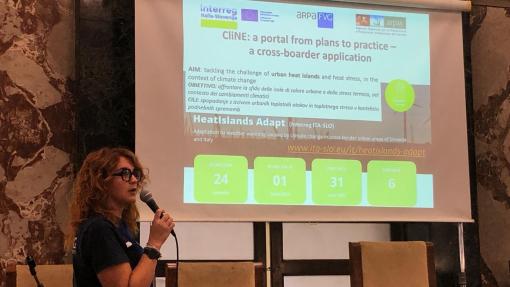
The presentation, titled “CliNE: A novel portal of the north-eastern Italy climate framework for the assessment of current and future climate-related impacts,” was delivered by ARPA FVG (coordinator of Work Package 1). In addition to showcasing the climate platform developed by ARPAV and ARPA FVG, the HeatIslands Adapt project was presented in detail, highlighting its innovative approach, which over the next two years will enable cross-border cooperation to address the complexity of climate change—an issue that transcends national borders and demands coordinated adaptation measures between the border areas of Friuli Venezia Giulia and Slovenia.
The conference provided an opportunity to present the project, its partners, and its overall aim: to reduce the effects of urban heat islands and to ensure adaptation measures for urban areas, thereby strengthening the resilience of cities and improving the quality of life for residents. The presentation continued with an outline of the work carried out within Work Package 1, aligned with the needs of all involved partners.
Particular attention was given to the three time horizons that guide the study of urban heat islands:
the past/present, analysed through climatology that provides the knowledge base;
the near future, through 3–5-day forecasts used to issue joint heat warning bulletins for both cross-border areas;
the distant future, through the CliNE platform (https://clima.arpa.veneto.it/), which will provide risk scenarios to support adaptation planning towards the end of the century.
All information produced within Work Package 1 will be used by the other project partners to foster cross-border alignment and develop procedures for unified, coordinated and timely communication with the population.
During the conference days, we also had the opportunity to present the project to other participants through a scientific poster highlighting the project’s key elements, further increasing its visibility beyond the specific scope of the Interreg Italy–Slovenia programme.