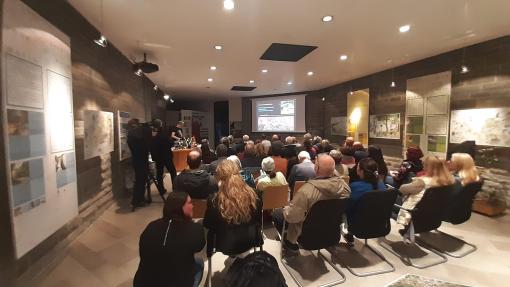
On March 19 at 6 p.m., a lecture titled Small is beautiful – science and art under the microscope was held at the reception center of the Val Rosandra Nature Reserve in Bagnoli della Rosandra, featuring Prof. Bernardo Cesare from the Department of Geosciences at the University of Padua. The lecture, co-organized by the associated partner Municipality of San Dorligo della Valle and partners UNIPD and the Geological Service of the Autonomous Region of Friuli Venezia Giulia, is part of the Interreg Italy–Slovenia Karst-Carso II project.
The event was also an opportunity to present a new feature at the reception center – a large illuminated panel that was part of the exhibition “Microworld of the Karst – shapes and colors captured in rocks,” which, after the conclusion of the exhibition, was donated to the Reception Center by the University of Padua.
The panel is dedicated to revealing the surprising shapes and colors hidden within the rocks of this area. On display is a rock sample from the former quarry in Bagnoli della Rosandra under a microscope: microfossils transform into striking compositions of shapes, textures, and colors, allowing science and art to tell the story of the geological heritage of the Karst.
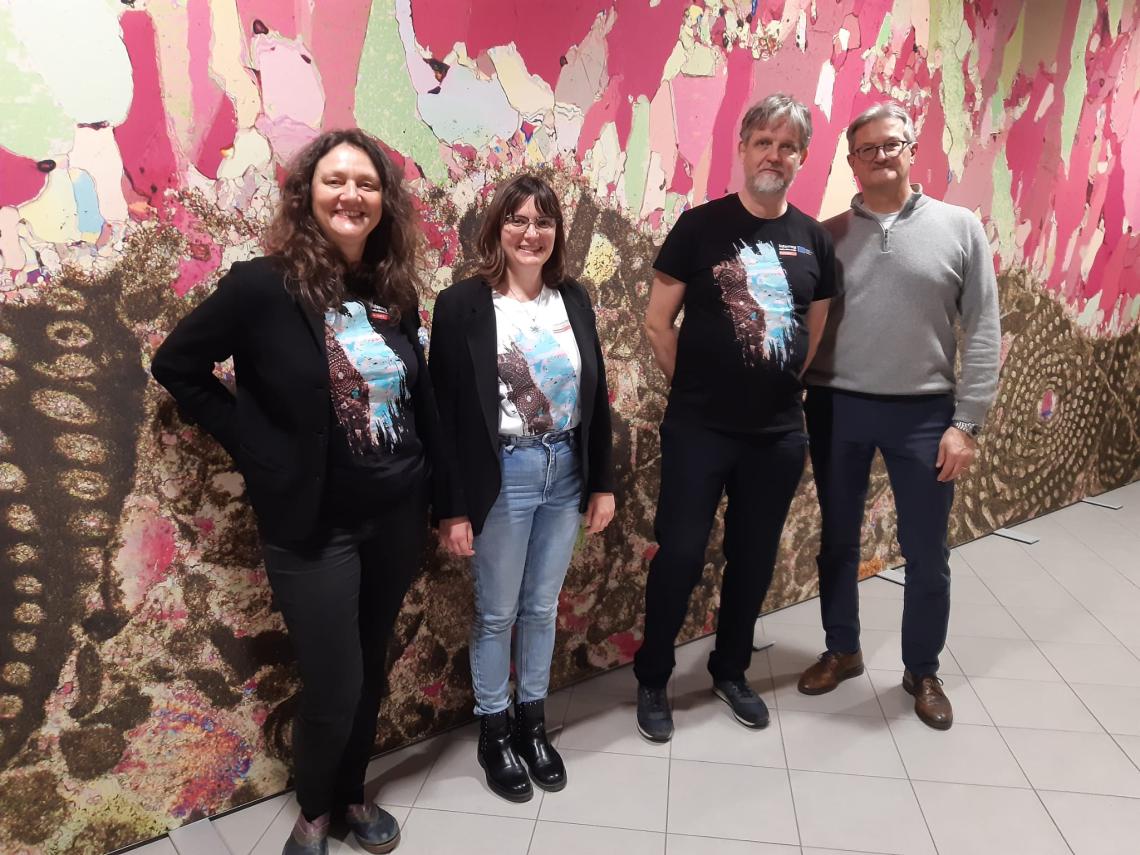
In the introductory lecture, Prof. Nereo Preto from UNIPD provided a popular-science explanation of what the large illuminated panel “Microworld of the Karst” presents. This was followed by a longer lecture by Prof. Bernardo Cesare, in which he presented, with exceptional expertise and in a simple way, the boundary between scientific research and artistic expression. Using microscopic images, he showed how the study of rocks can become an aesthetic experience.
The event was very well attended by representatives from both sides of the border and the wider partnership of the Kras-Carso II project, and it also served as an introduction to the traditional cross-border hike “Open Border,” which the Municipality of San Dorligo della Valle has been organizing since 1981 from Bagnoli della Rosandra to Beka in Slovenia, and can be considered a precursor to cross-border events also carried out within Interreg Italy–Slovenia projects.