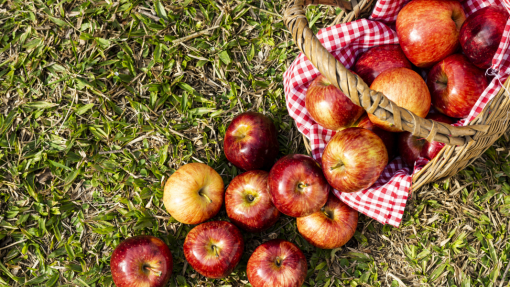
In the agri‑food landscape of the Italy–Slovenia area, the apple holds a historic role: a traditional crop deeply rooted in local territories, symbolising an agriculture that has long combined landscape, quality, and regional identity. Yet, alongside production destined for fresh consumption or processing, there is a parallel universe made up of peels, cores and leftover pulp—materials that for decades were considered mere processing waste.
Today, thanks to advances in biotechnological research and the growing focus on sustainable production models, these by‑products reveal a surprising potential: no longer a “dead end”, but the starting point for new high‑value value chains.
The apple is one of the most interesting matrices from a biochemical perspective. Its residual fractions are naturally rich in fibres, pectins, polyphenols and bioactive compounds that find applications not only in the food sector, but also in nutraceuticals and natural cosmetics.
The presence of antioxidant phytocompounds, for example, opens the door to functional ingredients for wellness‑oriented products, while the fibrous component can be used in the formulation of clean‑label foods designed for consumers increasingly attentive to natural ingredients.
Beyond technical aspects, the apple has another crucial strength: its continuous availability. Processing companies generate constant amounts of by‑products throughout the year—an important asset for those wishing to develop innovative products starting from a stable, local raw material that integrates easily into existing production cycles.
It is precisely this convergence of territorial availability, nutritional value and ease of transformation that makes the apple an emblematic case of circular bioeconomy, where every stage of the value chain can be rethought more efficiently.
Looking at waste with new eyes also means rethinking the role of enterprises: from simple users of raw materials to co‑producers of new ingredients. In a context where competitiveness increasingly depends on the ability to innovate sustainably, apple by‑products become a concrete opportunity to diversify, communicate added value and engage with growing markets.
And while research continues to refine increasingly green extraction technologies, the challenge for SMEs will be to translate this potential into prototypes, product lines, and collaborations with laboratories and companies in the region.
The opportunities are numerous: the apple reminds us every day that innovation can also grow from what, until yesterday, seemed to have no future.
THE DIGITAL MAP: a tool open to the innovation network
To support companies, researchers and stakeholders in exploring these opportunities, BioTech2Agri has developed an open‑source Digital Map, created on the Prezi platform.
The tool collects and visually organises the information gathered during the project’s analytical phase and allows users to explore:
- the plant species relevant to the territory,
- the biotechnologies applicable to different production domains,
- the public and private actors that make up the cross‑border innovation network.
The Map is designed to be intuitive, up‑to‑date and easily accessible to SMEs, researchers, public bodies and stakeholders, helping to bridge the gap between technology supply and innovation demand.
🔗 Digital Map – BioTech2Agri
https://prezi.com/view/k21QLuxRdonMySrwSm9F/
Immage by www.freepik.com