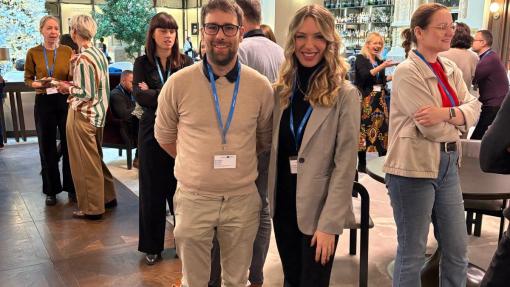
“AI won’t steal your job, but someone who knows how to use it might.” With this provocative statement, the event “Mind Meets Machine” kicked off. Held on November 25-26, 2025, in Bucharest, it brought together Interreg programmes to discuss how artificial intelligence is already transforming – and will continue to transform – cross-border cooperation. Nastja Foraus and Danijel Ferlez, Managing Authority support staff, participated by sharing the perspective of the Interreg Italy-Slovenia Programme in a discussion rich in pratical examples and concrete experiments.
From the outset, it emerged that AI is no longer an optional: understanding its possibilities and limitations is essential. Generative AI doesn’t just create text and images, but it also analyzes content, optimizes processes, and can be integrated into daily activities, as demonstrated by simple Excel formulas and tools already adopted by various European programmes. Alongside the benefits, the risks were also highlighted: high energy consumption, copyright issues, privacy concerns, and the reliability of results, which always require human review.
Several programmes shared their experiences: Central Europe established a dedicated team and published guidelines; North-West Europe uses permanent working groups and professional licenses to integrate AI into daily activities; North Sea developed the internal chatbox Starfish; Slovakia-Czechia launched a public platform with a 24/7 virtual assistant; Italy-Croatia introduced KLens, an advanced system for data verification and management; Latvia-Lithuania and Estonia-Latvia showcased lightweight yet effective solutions, proving that innovation is possible even with limited budgets.
The first day concluded with a podcast generated in real time by AI, based even on handwritten texts produced by the groups. The second day had an operational slant, with exercises dedicated to the use of AI for capitalization, which demonstrated how these tools can speed up complex analyses without replacing human judgment. The speech on audiovisual models was also very appreciated, highlighting how rapidly AI-generated images, videos, and content are evolving.
The event closed with a talk-show which summarized the essence of the two days: AI offers great opportunities but requires responsibility, attention, and balance. Interact announced that the AI meeting will become an annual event, with the next edition scheduled for September 2026.
The participation of Foraus and Ferlez enabled our programme to gather useful tools, new insights, and a clearer vision of the path ahead: AI will not replace human work, but it will transform it. It is up to us to get ourselves ready.