The international Study Visit promoted within the framework of the FIRESAFENET project—co-financed by the European Union under the Interreg VI-A Italy–Slovenia Programme—has come to a close. From 25 to 27 February, it brought together international experts involved in wildfire risk management for three days, creating an intensive opportunity for discussion and exchange of expertise.
ISIG, as a project partner, organized the Study Visit in collaboration with the Forest Fire Research Centre (CEIF), a research unit of the Association for the Development of Industrial Aerodynamics (ADAI), based at the University of Coimbra.
The initiative represented an important opportunity for exchanging best practices, innovative tools, and operational strategies among professionals, institutions, and the research community, concretely strengthening cross-border cooperation between Italy and Slovenia. The event is part of the FIRESAFENET project, which aims to enhance collaboration between the two countries in wildfire prevention, preparedness, and response. Through coordination and dialogue among operational actors, institutions, and research organizations, FIRESAFENET promotes a shared and integrated approach to risk management, strengthening the capacity of territories to effectively להתמודד wildfire-related emergencies.
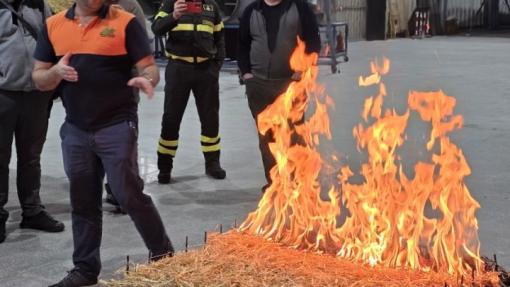
The first day opened at LEIF | Laboratory for Forest Fire Studies, located near Lousã Airport, about 27 kilometers from Coimbra. The laboratory is managed by the Forest Fire Research Centre (CEIF - ADAI), active since 1985 in applied research on fire behavior and safety in wildfire scenarios.
The second day took the delegation to the sites of the Pedrógão Grande tragedy, where in 2017 a devastating wildfire claimed the lives of 66 people, including civilians and first responders—an event that deeply marked the country’s recent history.
The Study Visit concluded on Friday, 27 February, with the international seminar “Wildfire management systems in Slovenia, Italy and Portugal,” hosted by the University of Coimbra at the Faculty of Mechanical Engineering.
The exchange highlighted the tangible value of European cooperation. Sharing knowledge, experience, and expertise—together with strengthening relationships based on trust and collaboration—represents a decisive step toward increasingly integrated and effective wildfire risk management.
For FIRESAFENET, the Portuguese stage was not just a study visit, but a testing ground: learning from a context historically exposed to fire in order to strengthen the resilience of the Italy–Slovenia cross-border area. An example of how memory, science, and cooperation can transform tragedy into shared knowledge and concrete action.