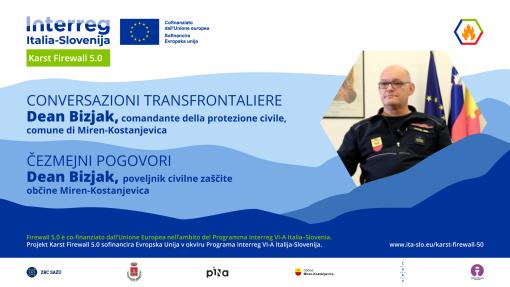
We sat down with Dejan Bizjak, Civil Protection Commander in the Municipality of Miren-Kostanjevica, to talk about fire prevention, local preparedness, and what it means to be part of a community vulnerable to natural disasters.
We’re welcomed into the municipal building by the steady, calm voice of a man who knows the terrain not just by map, but by heart. Dejan Bizjak leads the Civil Protection Unit of Miren-Kostanjevica, a team of nine local responders who support frontline services during emergencies. Their task isn’t to extinguish fires, but to make sure those who do have the gear, fuel, food and logistics they need to act fast and effectively.
How do you view the collaboration between field actors and project teams like Karst Firewall 5.0?
So far, the collaboration has been solid, but there’s always room for improvement. There’s a difference between what’s planned on paper and what actually happens in the field. The more information flows between developers and field teams, the better the systems will work in real-life situations.
How do you view the collaboration between field actors and project teams like Karst Firewall 5.0?
So far, the collaboration has been solid, but there’s always room for improvement. There’s a difference between what’s planned on paper and what actually happens in the field. The more information flows between developers and field teams, the better the systems will work in real-life situations.
Do you think local residents are well prepared?
To a certain extent, yes. People here have lived with this reality their whole lives — they know they live in a fire-prone area. But at the same time, there’s so much information from so many channels that it can become overwhelming or even misleading. I believe that local communication should be the primary source of information during crises. Messages from the civil protection unit, not just broad national media reports.
What should the public know about fire safety and prevention?
Trust your local teams. Listen to what the local coordination center is saying. National media can sometimes amplify or distort the picture. The most accurate and relevant updates are those given at the community level, the ones based on what’s actually happening on the ground.
What has the Karst Firewall 5.0 project brought to your team?
We’ve taken part in several trainings, though not all, since our unit consists of volunteers and it’s not always possible to attend everything. But what we did attend was useful. We also received equipment: protective gear and chainsaws, and ten of our members were trained to use them safely. So yes, the project has provided real, lasting value. The tools stay with us and that means we’re better prepared for the future.
It’s easy to think about fire when flames are already burning, but what Dejan reminds us is that true resilience starts long before that. In the way teams are equipped. In how neighbors communicate. In how seriously we take dry underbrush, broken coordination chains, or ignored local knowledge.
This interview is part of the series Cross-Border Conversations, which brings together voices from both sides of the Italy–Slovenia border. Through the lens of the Karst Firewall 5.0 project, the series highlights the knowledge, stories, and everyday realities of those working to strengthen resilience in a landscape increasingly shaped by climate change.