
Home
  • it
  • sl
  • en

Area riservata

  • Reserved Area

Navigazione principale

  • Programme
    • About Interreg IT-SI
      • Latest update
      • Financial allocation
      • Partnership involvement
      • Communication approach
      • Legislative framework
      • Other informations
      • Transparent Administration
    • Programme Area
    • Authorities and structures
    • Objectives
      • A smarter Europe
      • A greener Europe
      • A more social Europe
      • A better governance
    • Documents
      • Interreg Programme
      • Legislation
      • Monitoring Committee Documents
      • Italy-Slovenia Border Orientation Paper
      • Communication & visibility
      • Analysis documents
      • SEA Procedure
      • Environmental monitoring
      • State Aids
      • Management and control
      • Progamme Evaluation
      • Post 2027
    • Publications
    • Other programming periods
    • Privacy
    • Youth
      • Students4Cooperation
        • Guidelines and documents
        • Project ideas
        • Photos and videos
    • Synergies
      • Synergy map
      • MMM
      • Success stories
      • OSI Event
  • Projects
    • Financed projects
    • Project typologies
      • Strategic projects
      • Capitalization projects
      • Standard projects
      • Small scale projects
    • Project implementation
      • Communication
      • Expenditures and reporting
      • Project variations
      • Project closure
      • Videos and tutorials
      • Circular letters
    • Visual identity
    • SPF
    • FAQ
  • News & Events
    • News
    • Procurement and notices
    • PROJECT EVENTS
    • PROGRAMME EVENTS
    • INTERREG GO!
      • AGENDA
      • VENUES
      • PROJECT VISITS
      • YOUTH SIDE EVENT
        • Students4Cooperation
        • Interreg GO! Youth Event
      • NEWS
      • PHOTOS
      • CONTACTS
  • MEDIA GALLERY
  • Calls
    • Open calls
    • Closed calls
  • Contacts
  • Jems
  • 2028-2034
    • 2028–2034
      • Documents
      • Legislative framework
      • Planning phase
      • Learn more
  • it
  • sl
  • en
Follow us

Main navigation

  • Programme
  • Projects
  • News & Events
  • MEDIA GALLERY
  • Calls
  • Contacts
  • Jems
  • 2028-2034

Main navigation

  • News
  • Procurement and notices
  • PROJECT EVENTS
  • PROGRAMME EVENTS
  • INTERREG GO!

The Early Modern Development of the Area between the Alps and the Adriatic: the Kobencl Family

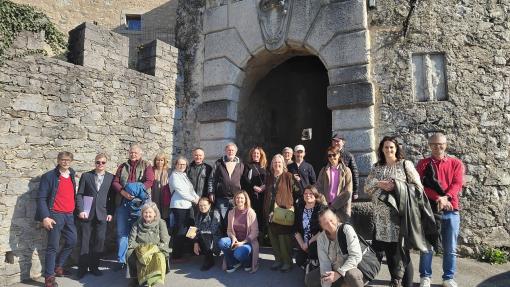
On Thursday, 26 February 2026, a one-day professional training course for tourist guides was held at Štanjel Castle, organized by the Association of Tourist Guides of the Karst and Brkini and the Regional Development Agency (ORA) of the Karst and Brkini Ltd. The event focused on the political, social, and economic development of the area along the northeastern Adriatic from the 16th to the early 19th century and highlighted the noble Kobencl family.
 

The transition from the Middle Ages to the Early Modern period in the area between the Julian Alps and the Adriatic Sea represented a profound transformation of society. This region, located at the crossroads of Slavic and Romance cultural spheres, experienced an intensified influence of broader European currents during this period—from the consolidation of Habsburg authority to the development of trade, new administrative structures, and changes in military organization. These processes shaped the daily life of the population, transformed social relations, and stimulated economic development along the northeastern Adriatic.


Particular attention during the training was given to the Kobencl family, which, despite its historical significance, remains relatively little studied and largely unknown to the general public. Their history represents an interesting example of social ascent—from an originally peasant background to a noble family whose members held important diplomatic and administrative positions in the service of the Habsburg state.


The influence of the Kobencl family has also left a lasting mark on the architectural character of Štanjel. Their legacy was crucial in shaping the present-day appearance of the Karst settlement, including the preserved and restored castle palace, which today represents an important part of the cultural heritage.
 

The academic part of the training was prepared and conducted by Valentin Medvešček, a graduate historian and master’s student in history at the University of Primorska. In his research, he systematically focuses on the study of the Kobencl family and the broader political and economic processes of the Early Modern period in Slovenia and neighboring regions. Through lectures and a field visit, he introduced participants to the complexity of historical changes and the importance of understanding local heritage within a wider European context.
 

The event once again highlighted that an in-depth knowledge of history forms the foundation for high-quality interpretation of cultural heritage. For tourist guides presenting our region to visitors, such professional training represents an important step toward a comprehensive and responsible presentation of the area’s historical identity.
 

The event was organized as part of the KRAS-CARSO II project, co-funded by the European Union under the Interreg VI-A Italy–Slovenia 2021–2027 Programme.

Logo Kras-Carso II
Strokovno usposabljanje na gradu Štanjel
published on 08. 3. 2026

Programme

  • About Interreg IT-SI
  • Programme Area
  • Authorities and structures
  • Objectives
  • Documents
  • Publications
  • Other programming periods
  • Privacy
  • Youth
  • Synergies

Projects

  • Financed projects
  • Project typologies
  • Project implementation
  • Visual identity
  • SPF
  • FAQ

News & Events

  • News
  • Procurement and notices
  • PROJECT EVENTS
  • PROGRAMME EVENTS
  • INTERREG GO!

Mediagallery footer

  • Media gallery

Calls

  • Open calls
  • Closed calls

Contatti footer

  • Contacts

Preferenze sui Cookies

  • Cookie Settings
Follow us

This website is co-financed by the European Union in the framework of the Interreg VI-A Italy-Slovenia 2021-2027 programme