This academic year, we continue to organise biological evenings, prepared by the staff of the Department of Biodiversity at UP FAMNIT. This series of lectures aims to popularise various topics in biology and nature conservation. This time, the series is mainly devoted to subjects related to the Kras4us project, funded by the Interreg VI-A Italia-Slovenia 2021–2027 programme.
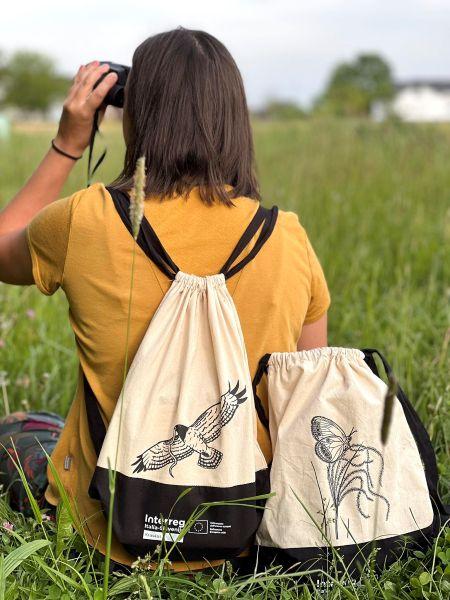
The first lecture in the series was given by conservation biologist Manja Tišler on 10 December 2026. We invited her to present her work, as her illustrations of some typical but rare speciesin this area, such as short-toed snake-eagle and false ringlet also feature in the project's promotional material.
Manja presented the importance of scientific and natural history illustration, which has accompanied humanity since the very beginning. As she explained, humans have always depicted nature through art. The earliest illustrations include prehistoric cave paintings, where people depicted animals and natural phenomena on cave walls. The most significant transformation occurred between the 16th and 18th centuries, during the Scientific Revolution, when fundamental changes in scientific methods took place due to a move away from church dogma and the establishment of empirical thinking.
The first scientific bestseller for the general public, which, through a series of illustrations, enabled readers to glimpse objects through the eyes of a microscope, was Micrographia by Robert Hooke (1635–1703). His illustration of a flea remains one of the most famous in the book and is still valued by researchers worldwide for its accuracy.
Despite modern photographic technology, illustration remains indispensable, as it can encompass, emphasise, and interpret even the smallest processes and details that photography cannot capture with such precision.
During the lecture, Manja Tišler emphasised that, at its core, scientific illustration is the visual communication of science and represents a key and necessary element of accurate scientific communication. She is the author of numerous scientific illustrations across Slovenia, including those on the forest educational trail Tromejnik by Lake Ledava, along the wooden bridge over the salt meadow in Ankaran near Sv. Nikolaj, at the Ankaran shell site on Sv. Katarina, at the Natural History Museum of Slovenia, in the Ljubljana Marshes Landscape Park along the Pot na Mah thematic trail, which won first place in the Best Thematic Trail category in 2024, and many others.