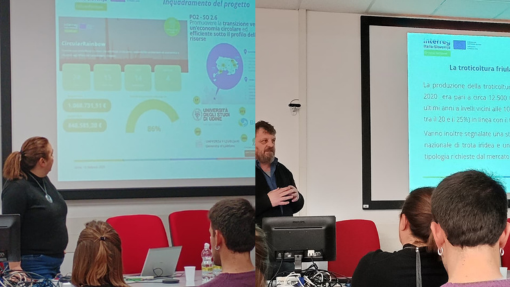
On 13 February 2026, the event “Circular Rainbow Lab – Consultation with the Italian fish farmers’ group” took place at the Department of Agricultural, Food, Environmental and Animal Sciences (Di4A), University of Udine, in the Sala della Vite e del Vino (Wine and Vine Room). The event was organised as part of the CIRCULAR RAINBOW project.
The Circular Rainbow Lab is a process of dialogue and cooperation involving fish farmers, researchers, experts and institutional representatives. Its aim is to identify practical solutions to support the trout farming sector in moving towards more sustainable, efficient and climate-resilient production models. The meeting was attended by representatives of fish farming businesses, the University of Udine, the Friuli Venezia Giulia Regional Government, and Federica Cisilino, representing CREA, an associated partner of the project. The meeting represented the consultation phase with the Italian fish farmers’ group, following an initial survey and the identification of farms interested in the transition. Its objectives were to examine the challenges associated with current production models, assess the potential benefits and difficulties of converting to recirculating aquaculture systems (RAS), and validate the assumptions and estimates of the project's techno-economic analysis against the practical experience of sector operators.
The meeting opened with a presentation by professor Gloriana Cardinaletti (University of Udine), who outlined the project's objectives and highlighted the importance of developing climate change prevention and adaptation strategies. She also presented the digitalised RAS pilot system developed by the University of Udine.
Professor Roberto Pastres (Bluefarm srl) then introduced the main aquaculture systems currently used in trout farming: flow-through systems (FTS), hybrid systems (HFS), intermediate-technology recirculating aquaculture systems (RAS ITL) and high-technology recirculating aquaculture systems (RAS HTL). He also presented the methodologies and preliminary findings of the techno-economic analysis, focusing in particular on the conversion of FTS facilities to HFS and the development of small-scale RAS facilities.
The discussion involving representatives of fish farming businesses, researchers and regional authorities provided an opportunity to explore three main topics:
• Climate change adaptation and water availability. Fish farmers confirmed that the effects of climate change are becoming increasingly evident, including reduced water availability, rising water temperatures and extreme weather events. There was strong interest in solutions capable of reducing water abstraction while maintaining current production levels. In this context, a gradual transition from FTS to hybrid HFS systems was considered a feasible option with potential benefits in the medium term.
• Product quality and consumer perception. Fish farmers highlighted the need to strengthen communication with consumers and promote the quality of Italian trout farming and local production. The possibility of combining RAS and FTS technologies was also discussed, for example by using recirculating systems during the initial stages of fish rearing and flow-through systems during the final stage, in order to combine the advantages of the two technologies.
• Validation of the techno-economic analysis. The discussion broadly confirmed the validity of the assumptions used in the analysis, while suggesting some adjustments to the estimates of staffing requirements and taxation, in order to make the assessments more consistent with the actual operating conditions of fish farming businesses.
During the presentation, Andrea Fabris, Director of API, also highlighted the importance of using the correct terminology in line with applicable regulations. In particular, he stressed the need to use the term “livestock effluents” rather than “sludge” to describe the suspension collected by the mechanical filter in RAS facilities, ensuring that the materials and their treatment processes are properly classified.
The consultation confirmed the importance of adopting a gradual and flexible approach to technological transition. There is no single solution suitable for all farms; rather, innovation pathways need to be tailored to the production characteristics and investment capacity of each business. The exchange with fish farmers therefore represents a key step towards developing practically applicable circular trout farming models, capable of strengthening the resilience of the sector and supporting its adaptation to future environmental and economic challenges.