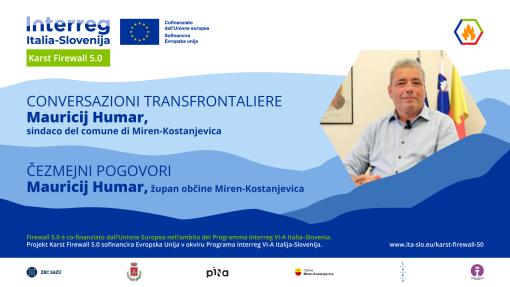
When a wildfire hit Miren-Kostanjevica in 2022, it became the largest in Slovenia’s recorded history. The damage left a mark, but so did the lessons. Today, the municipality stands not only better equipped, but also more connected, aware, and prepared. We visited Mayor Mauricij Humar to talk about how his community is turning painful experience into lasting resilience.
He remembers the summer of 2022 clearly.
“Three years ago, we experienced the largest wildfire ever recorded in Slovenia. And we learned a lot from it. But more importantly, in these last few years, we’ve taken steps forward: we’ve raised awareness, improved equipment, strengthened people’s knowledge. If a fire breaks out today, we are much better prepared than we were three years ago.”
The fire involved four Slovenian municipalities and three Italian ones.
“We saw how important communication was and how essential it is to exchange data quickly and accurately. That’s the only way firefighters can react efficiently. Back then they already had some equipment and data tools, but we’ve made big progress since.”
The municipality invested in upgrades and systems that support better cooperation with other emergency response units.
“The equipment has to be compatible with public institutions and with other protection and rescue teams. That’s the only way they can act fast and effectively. In wildfires, reaction speed is everything. The faster the response, the easier it is to contain and extinguish a fire.”
“Fires don’t stop at the border.”
“We saw how well our teams cooperated with cross-border teams in Italy. Projects like Karst Firewall help connect us even more. If we use the same databases, if we have compatible equipment, we can respond more easily. That’s absolutely necessary.”
Humar says he’s glad that they have all recognised that. “These EU programmes and calls are meant to support this kind of work. Already during the application, I was confident that we had strong potential, and once the project is complete, we’ll all be able to sleep a little easier.”
“Our public is much more aware now.”
“On days with high fire risk, we all need to act responsibly. Please follow the guidelines. We now have equipment such as cameras, thermal cameras, drones. These things help detect fires faster. But most of all, it’s our responsible behaviour that prevents fires from starting in the first place.”
“We all have a role. Everyone can help prevent fires.”
“Even when fires happen out of ignorance, by using tools that are forbidden or just not smart to use in dry conditions, the damage can be massive. I believe the wildfire in 2022 was a wake-up call. It pushed all of us toward more responsible behaviour. And I’m glad to see young people are very active in this area too. I believe our local fire brigades won’t have trouble finding new members in the future.”
This interview is part of the series Cross-Border Conversations, which brings together voices from both sides of the Italy–Slovenia border. Through the lens of the Karst Firewall 5.0 project, the series highlights the knowledge, stories, and everyday realities of those working to strengthen resilience in a landscape increasingly shaped by climate change.