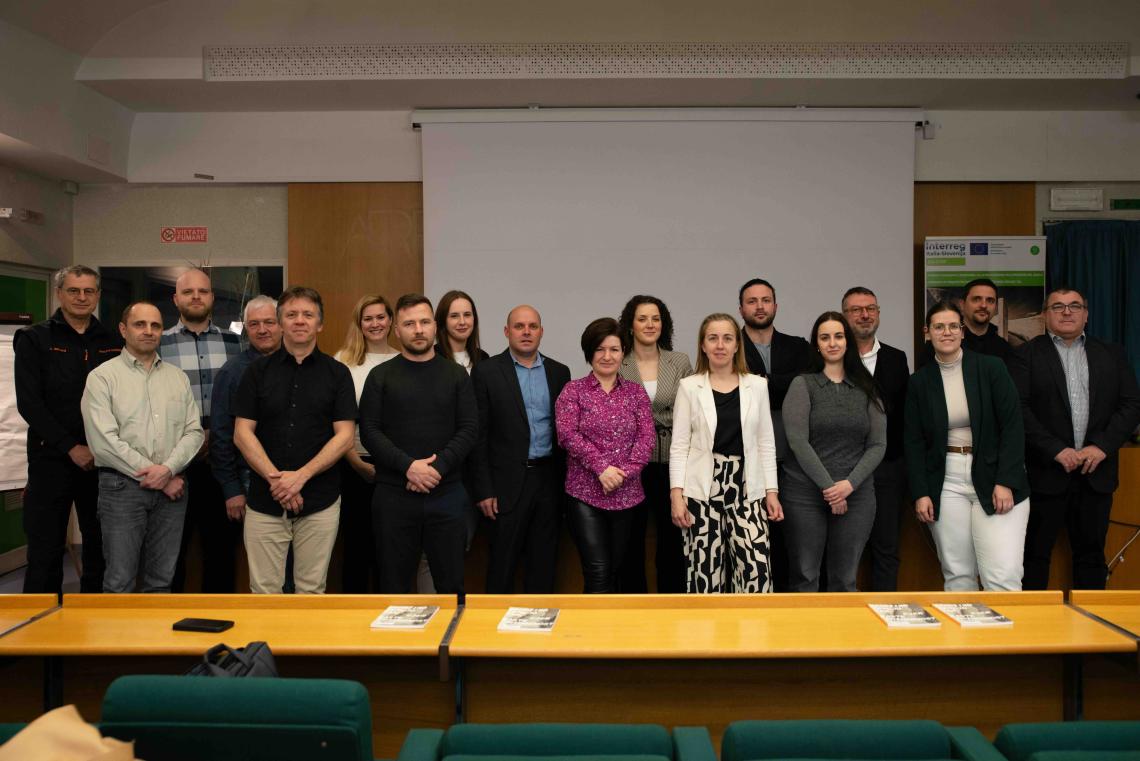
The final conference of the European project Ero-STOP – Advanced and Sustainable Approaches to Soil Erosion Prevention, co-financed by the European Union under the Interreg VI-A Italy-Slovenia Programme, was held this morning in the conference hall of the Area Science Park in Padriciano. After two years of activity, the project has reached its final phase, delivering concrete technical, scientific, and regulatory results, but above all, leaving behind a legacy of cross-border collaboration destined to continue over time.
The proceedings opened with institutional greetings from Jana Čuk, Director of the Nova Gorica Agroforestry Institute (KGZ NG), who emphasized the value of Interreg programs in connecting institutions, regions, and different expertise. "These projects are important because they create real connections between organizations and people," she emphasized, "and the most positive thing is to see that the working group is already discussing how to continue beyond the project's conclusion." A key step, accompanied by the awareness that without the support of European funds, many of these activities would be difficult to continue.
In the institutional message sent by the Slovenian Ministry for Cohesion and Regional Development, coordinator Jan Capuder praised the work done, highlighting how the project addressed a concrete problem with an innovative and cross-border approach: "Erosion knows no borders, and for this very reason, solutions must arise from cooperation between experts from different regions." Adaptation to climate change, he noted, is now a strategic priority at the European level. Along the same lines, the speech by State Secretary of the Ministry of Agriculture, Forestry and Food, Maša Žagar, drew attention to the importance of protecting agricultural soils: "Rural areas are crucial for food production, but they can be compromised even very quickly. Awareness is needed, and this often arises precisely in moments of crisis, when the need for action is truly understood."
Karmen Bizjak Bat, Ero-STOP manager for the lead partner Kmetijsko gozdarski zavod Nova Gorica, reviewed the project, highlighting the main results achieved over the two years of work, for a total investment of €983,410. "We analyzed existing legislation, developed improvement proposals, developed technical documentation, and implemented pilot activities in erosion-prone areas," she explained, also highlighting the awareness-raising efforts aimed at farmers and citizens. Among the main outputs were the preparation of the foundations for regulatory improvements at the Italian and Slovenian levels and the development of a cross-border action plan, developed thanks to the direct involvement of local stakeholders through workshops organized between Ajdovščina and Portogruaro. The project also had a strong outreach component, with the production of informational materials and the dissemination of results through various channels, from print to television. "We wanted to reach different audiences," added Bizjak Bat, "not just farmers but also the general public, because erosion prevention concerns everyone."
On a scientific level, Alberto Bonora of the IUAV University of Venice highlighted how agricultural techniques can significantly reduce erosion, especially in Italy's lowland areas. Using simulation models, various scenarios were analyzed related to the introduction of practices such as cover crops and direct seeding. "The simulations show measurable reductions in erosion," he explained, "for example, with cover crops such as mustard and horseradish, but also with conservation tillage techniques that avoid intensive soil cultivation." Furthermore, increasing soil organic matter, while having a more limited impact, contributes to improving soil resilience in the long term.
From Slovenia, Timotej Verbovšek of the University of Ljubljana presented the results of analyses on hilly areas, particularly in the vineyards of the Vipava Valley, where erosion and landslides often overlap. Using models such as RUSLE and SIMWE, the research team sought to quantify erosion phenomena and identify the most vulnerable areas. "In some cases, we're talking about several tons of soil lost per hectare each year," they noted, emphasizing the need for solid technical foundations to support farmers in their operational decisions. Among the recommendations that emerged were soil strengthening, more careful management of agricultural use, and the availability of guidelines applicable at the local level.
The regulatory issue was explored in depth by geologist Giulio Lauri, who highlighted how Italy already has a broad legislative framework for soil conservation, but it is often fragmented. "The tools exist," he explained, "but a unified vision and, above all, effective preventive planning are lacking." Among the key references are the 1923 hydrogeological constraint, basin plans, and the principle of hydraulic invariance introduced in 2010, according to which any land transformation must not worsen existing hydraulic conditions. However, Lauri noted, systematic mapping of soil vulnerability at the national level and widespread implementation of basin plans are still lacking. Among the proposals that emerged: the creation of a single text on soil erosion, the development of dedicated maps, incentives for conservative agricultural practices, and innovative tools such as soil and landscape contracts, inspired by river contracts, to foster cooperation between territories with similar critical issues.
Vasja Juretič (KGZ Nova Gorica) offered a look to the future, emphasizing that the expert group's work will not end with the project's conclusion. "It will take time to achieve optimal results," she explained, "because the erosion problem is different in Italy and Slovenia: plains on one side, hills on the other. An integrated and shared approach is needed." Juretič also emphasized the role of human activity in erosive processes, noting that erosion is often the result of an interaction between natural factors and human intervention.
Completing the presentation was the contribution of the Eastern Veneto Land Reclamation Consortium, with Deputy Director Graziano Paulon illustrating the connections between erosion, hydraulic management, and land use planning in the Litoranea Veneta, the subject of the Poseidone project, another Interreg project aimed at soil conservation. The remediation of the northeastern Venetian lagoon represents an example of an intervention that combines hydraulic safety, tourism accessibility, and landscape enhancement, achievable with a total contribution of €133 million.
The conference concluded with a speech by Professor Nejc Bezak, who offered a broader perspective on climate change and the effects it is having on the project areas, reiterating how the increase in extreme events makes it increasingly urgent to develop effective adaptation strategies. The conclusion of Ero-STOP marks the end of a journey of research and experimentation, but also marks the beginning of a new phase, in which the knowledge gained must be translated into concrete actions, more informed territorial policies, and stable cooperation between Italy and Slovenia. Because, as was evident several times throughout the day, soil erosion is not just an environmental problem, but a question that directly affects the future of the territories and their ability to withstand ongoing changes.