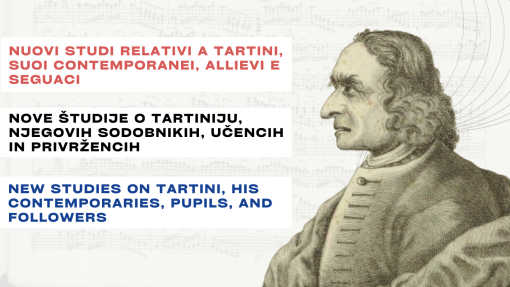
The TARTINI BIS project has enabled new research activities in the field of musicology, aimed at increasing studies on the works and figure of Giuseppe Tartini, finding and making available new sources, both with regard to the musical production and the scientific output of the great Piranese.
The hundreds of sources mentioned above have been digitised and catalogued in the archival section of the discovertartini.eu website to be immediately available to scholars and researchers.
Five senior researchers, three junior researchers and two expert archivists have been selected by two public calls issued by the “Tartini” Conservatory of Trieste and by the “Benedetto Marcello” Conservatory in Venice.
All the experts worked in a coordinated manner, and the concerted activities between senior and junior experts during the project was found as an added value in the various workshops and in the continuous communication between the project's scientific managers and researchers.
Tangible results of these activities are the reports of the five senior experts published here, which explicit the results of the research work and provide new information and insights into Giuseppe Tartini's artistic and scientific activity, his biography and the circle of his pupils and admirers.
These, in detail, are the titles of the five reports:
Margherita Canale
The violin and ensemble concertos of Giuseppe Tartini. Insights into violin concertos not included in the Dounias catalogue, with a focus on concertos with authenticity to be ascertained (Italian / Slovene)
Agnese Pavanello
Tartini's music for academies and Giulio Meneghini's Concertoni. Performances of Tartini's music in Padua in the 18th century. (Italian / Slovene)
Sergio Durante
Tartini: friends, enemies. Notes for a psycho-biography. (Italian / Slovene)
Federico Lanzellotti
Giuseppe Tartini's compositions in Venetian music collections. (Italian / Slovene)
Juan Mariano Porta
Around Giuseppe Tartini's Six concertos in four parts. (Italian / Slovene)
Some of the papers, notably those by Professors Durante and Pavanello, capture Giuseppe Tartini in the everyday life of his action, show a vivid and reliable cross-section of his social relations, his professional and friendship ties, the musical practices in use in 18th-century Paduan salons, and the reception in amateur musical circles with their demand for ad hoc musical compositions. The papers by Professor Margherita Canale (Conservatorio Tartini in Trieste) and Professors Federico Lanzellotti (University of Basel) and Juan Mariano Porta (University of Padua) are more focused on pure research and practically demonstrate the procedures and practices of musicological research. It is a fundamental and exciting work, especially since the subject of the research largely concerns musical materials that have come down to us in manuscript.