Home
  • it
  • sl
  • en

Area riservata

  • Reserved Area

Navigazione principale

  • Programme
    • About Interreg IT-SI
      • Latest update
      • Financial allocation
      • Partnership involvement
      • Communication approach
      • Legislative framework
      • Other informations
      • Transparent Administration
    • Programme Area
    • Authorities and structures
    • Objectives
      • A smarter Europe
      • A greener Europe
      • A more social Europe
      • A better governance
    • Documents
      • Interreg Programme
      • Legislation
      • Monitoring Committee Documents
      • Italy-Slovenia Border Orientation Paper
      • Communication & visibility
      • Analysis documents
      • SEA Procedure
      • Environmental monitoring
      • State Aids
      • Management and control
      • Progamme Evaluation
      • Post 2027
    • Publications
    • Other programming periods
    • Privacy
    • Youth
      • Students4Cooperation
        • Guidelines and documents
        • Project ideas
        • Photos and videos
    • Synergies
      • Synergy map
      • MMM
      • Success stories
      • OSI Event
  • Projects
    • Financed projects
    • Project typologies
      • Strategic projects
      • Capitalization projects
      • Standard projects
      • Small scale projects
    • Project implementation
      • Communication
      • Expenditures and reporting
      • Project variations
      • Project closure
      • Videos and tutorials
      • Circular letters
    • Visual identity
    • SPF
    • FAQ
  • News & Events
    • News
    • Procurement and notices
    • PROJECT EVENTS
    • PROGRAMME EVENTS
    • INTERREG GO!
      • AGENDA
      • VENUES
      • PROJECT VISITS
      • YOUTH SIDE EVENT
        • Students4Cooperation
        • Interreg GO! Youth Event
      • NEWS
      • PHOTOS
      • CONTACTS
  • MEDIA GALLERY
  • Calls
    • Open calls
    • Closed calls
  • Contacts
  • Jems
  • 2028-2034
    • 2028–2034
      • Documents
      • Legislative framework
      • Planning phase
      • Learn more
  • it
  • sl
  • en
Follow us

Main navigation

  • Programme
  • Projects
  • News & Events
  • MEDIA GALLERY
  • Calls
  • Contacts
  • Jems
  • 2028-2034

Main navigation

  • News
  • Procurement and notices
  • PROJECT EVENTS
  • PROGRAMME EVENTS
  • INTERREG GO!

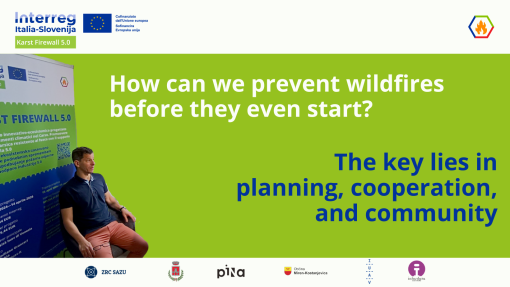
How can we prevent wildfires before they even start? The key lies in planning and cooperation

Wildfires in the Karst are no longer an exception – they are becoming increasingly frequent and intense. After the devastating fires of 2022, which affected more than 4,000 hectares, one thing became clear: safety is not only about firefighting, but above all about prevention.

Karst Firewall 5.0 places exactly this at the center – how wildfire risks can be reduced already at the stage of spatial planning, landscape management, and everyday decisions.

In a recent interview with the project’s lead partner, key challenges and solutions for reducing wildfire risks in the cross-border Karst area were presented.

Fire does not know borders

The Karst is a cross-border region between Slovenia and Italy, where fires can quickly spread from one country to another. This makes cooperation essential.

The project brings together researchers, municipalities, firefighters, foresters, civil protection units, and local communities – all working toward a shared goal: reducing wildfire risks and protecting people and nature.

Less firefighting, more prevention

“The idea is to do as much preventive work as possible before wildfires even spread,” emphasizes Dr. Massimiliano Granceri Bradaschia, project leader.

The project develops:

  • vulnerability and risk maps,
  • predictive wildfire models,
  • digital tools for early detection,
  • and concrete on-the-ground measures.

The goal? Fewer interventions, less damage, and greater safety.

How landscape can protect against fire

One of the project’s key findings is that the way we manage space significantly influences how fires spread.

Dispersed construction within forest areas increases risk. In contrast, compact settlements surrounded by agricultural or grassland areas are much safer and more resilient.

Such “buffer zones” can slow down or even stop the spread of fire.

The key role of the community

Technology alone is not enough. Everyday decisions made by people also play a crucial role.

From land management to participation in local initiatives – it is the community that can make the biggest difference in wildfire prevention.

A voice that needs to be heard

The project also highlights the importance of communication and public engagement.

Only if information reaches people can behavior change – and with it, the level of risk.

Read the full interview HERE.
Access the full Spring 2026 issue of EU Research magazine HERE.
Karst Firewall 5.0
Karst Firewall 5.0
published on 30. 3. 2026

Programme

  • About Interreg IT-SI
  • Programme Area
  • Authorities and structures
  • Objectives
  • Documents
  • Publications
  • Other programming periods
  • Privacy
  • Youth
  • Synergies

Projects

  • Financed projects
  • Project typologies
  • Project implementation
  • Visual identity
  • SPF
  • FAQ

News & Events

  • News
  • Procurement and notices
  • PROJECT EVENTS
  • PROGRAMME EVENTS
  • INTERREG GO!

Mediagallery footer

  • Media gallery

Calls

  • Open calls
  • Closed calls

Contatti footer

  • Contacts

Preferenze sui Cookies

  • Cookie Settings
Follow us

This website is co-financed by the European Union in the framework of the Interreg VI-A Italy-Slovenia 2021-2027 programme