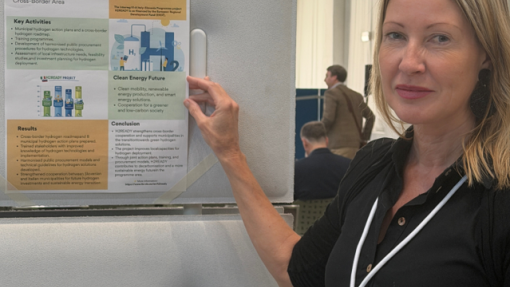
During the 2026 edition of the FEDARENE General Assembly (European Federation of Regions and Energy Agencies), held in Modena, GOLEA also presented the H2READY project – The Future of Hydrogen in the Cross-Border Area, implemented under the Interreg VI-A Italy–Slovenia 2021–2027 Programme, to the international community. The project was presented to participants by Suzana Vidmar Kovšca, who highlighted the importance of the initiative for the development of hydrogen-based solutions and for the involvement of local communities in the energy transition.
The H2READY project addresses one of the key challenges of the energy transition in the cross-border area between Slovenia and Italy: connecting strategic hydrogen initiatives with the real needs of the territory and enabling local communities to take a more active role in the deployment of hydrogen-based solutions. The project therefore underlines the fundamental role of local authorities as a bridge between energy needs, infrastructure development, and the sustainable development of the territory.
During the presentation, it was emphasized that the development of the hydrogen economy is currently still largely focused on industry and research institutions, while local communities continue to play only a limited role in the preparation of hydrogen-related strategies. H2READY aims to reduce this gap and to connect broader macro-regional initiatives, such as the North Adriatic Hydrogen Valley (NAHV), with local needs and concrete project activities on the ground.
Suzana Vidmar Kovšca introduced the participants to the project’s main objectives, including the preparation of action plans for pilot municipalities, the development of a cross-border joint public procurement model for hydrogen solutions, and the drafting of a strategic Masterplan for the long-term development of the hydrogen ecosystem in the cross-border area. Particular attention was also devoted to capacity-building activities for local administrations and to the development of methodologies and tools supporting the planning of hydrogen-related projects within municipalities.
The presentation also highlighted the involvement of Slovenian and Italian pilot municipalities and the analysis of different territorial needs — ranging from sustainable mobility and public transport to the development of infrastructure for the production, distribution, and use of green hydrogen. The project also addresses the current administrative and organisational barriers that make the development of shared cross-border hydrogen solutions more complex.
The presentation of the H2READY project attracted significant interest among the event participants, as many European regions are facing similar challenges related to the involvement of local communities in the development of the hydrogen economy and in defining governance and development models for future investments in the sector. Following the presentation, a discussion took place with participants, during which numerous questions emerged regarding the transferability of good practices, opportunities for interregional cooperation, and links with other European hydrogen initiatives.
Participation in the FEDARENE General Assembly 2026 represented an important opportunity for the international promotion of the H2READY project and for strengthening the visibility of cross-border cooperation between Slovenia and Italy in the field of hydrogen technologies and sustainable energy transition. The role of GOLEA as lead partner of the project and as an active promoter of local community involvement in the development of future hydrogen-based solutions was also highlighted.