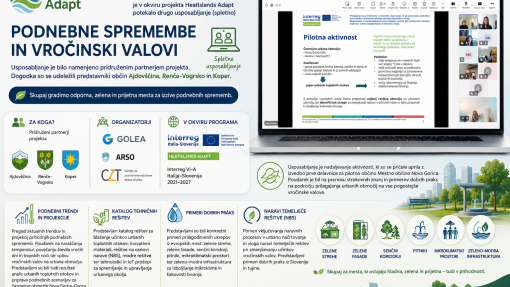
On 6 May 2026, within the framework of the HeatIslands Adapt project, the second training session (this time held online) titled “Climate Change and Heatwaves” took place, aimed at the project’s associated partners. Representatives from the municipalities of Ajdovščina, Renče-Vogrsko and Koper participated in the event. The training was organised by GOLEA in cooperation with ARSO and CZT under the Interreg VI-A Italy–Slovenia 2021–2027 programme.
The training represents a continuation of activities that began in April with the first workshop for the pilot municipality of Nova Gorica. This time, the focus was on associated project partners and on transferring expert knowledge and best practices related to adapting urban areas to increasingly frequent heatwaves.
In the first part of the event, GOLEA presented the HeatIslands Adapt project and the results achieved so far. This was followed by a presentation from an ARSO representative, who provided an overview of current climate trends and projections of future climate change. Particular emphasis was placed on rising temperatures, the increasing number of hot days and tropical nights, and the impacts of heatwaves on urban areas. Participants were also introduced to the results of urban heat island analyses and the development of climate scenarios for the cross-border area of Nova Gorica–Gorizia.
GOLEA then presented a catalogue of technical solutions for mitigating the effects of urban heat islands, developed within the project. Participants were introduced to various approaches to reducing urban overheating, including the use of innovative materials, nature-based solutions (NBS), blue solutions, as well as technological and IoT-based approaches for monitoring and managing the urban environment.
Special attention was given to concrete examples of adaptation measures from European cities, such as green roofs, green façades, shaded corridors, drinking fountains, microclimatic spaces, and the development of green-blue infrastructure to improve microclimate and quality of life in urban areas.
A representative of the University of Nova Gorica/CZT highlighted the importance of integrating natural processes into urban planning and emphasised the role of nature-based solutions in reducing the effects of heatwaves. The presentation also included examples of good practices from Slovenia and abroad, underlining the importance of long-term strategic urban planning in the context of climate change.