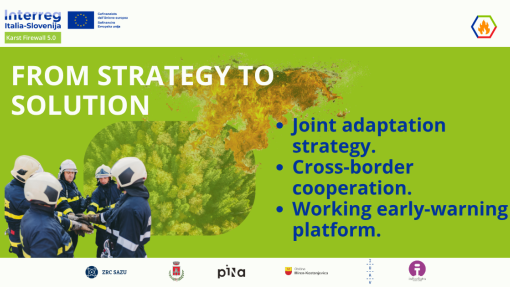
The Karst Firewall 5.0 project has achieved three key direct outputs, as defined in the application form, which together represent the journey from scientific analysis, through cross-border cooperation, to a concrete technological solution for wildfire prevention on the Karst.
O.1.1 – Joint Development of Wildfire Adaptation Strategies in the Cross-Border Karst Area
This output combines scientific wildfire hazard and vulnerability analyses (MaxEnt modelling and MCDA/AHP multi-criteria analysis) with an extensive handbook of concrete risk-reduction measures. Each measure – from selective removal of flammable material, firebreaks, and dry stone wall maintenance to targeted grazing and building bans in the most at-risk areas – is defined by the risk component addressed, land use, spatial planning level, and stakeholders involved. The result corresponds to programme indicator RCR79 (joint strategies and action plans).
O.1.2 – Cross-Border Cooperation of Organisations for Wildfire Prevention on the Karst
The document presents an overview of the six organisations that formed the project partnership – IUAV, Infordata Sistemi, the Municipality of Duino-Aurisina, the Municipality of Miren-Kostanjevica, PiNA, and ZRC SAZU – along with two associated partners (the Regional Forestry Corps of Friuli Venezia Giulia and the Slovenian Forest Service). It describes how cooperation between them developed through joint analyses, on-the-ground pilot measures, participatory workshops, and the final conference, and how it continues beyond the project's conclusion — through shared maintenance of the digital platform, long-term monitoring of pilot areas, and preparation for future cross-border applications. The result corresponds to indicator RCR84 (organisations cooperating cross-border after project completion).
O.2.1 – Innovative Solution for Karst Fire Prevention and Early Warning
This is the project's core technological result: a cross-border digital platform integrating the first joint historical database between Italy and Slovenia (over 5.2 million weather records, nearly 4,000 recorded fires), a locally calibrated predictive index — the Karst Fire Weather Index (K-FWI) — a network of weather stations and IoT sensors ("electronic noses"), an early-warning system in four languages, and a public portal (https://kf50.infordata.it/portal). The combined model detects 77.5% of fires, compared to 29% for the traditional meteorological approach. The platform is already in use: 33 organisations hold approved user accounts, the registry contains 423 locations and 410 firefighting teams, and the public portal recorded nearly 3,500 views in one month. The result corresponds to indicator 2.1.1 (jointly developed pilot measures).
Together, these three results demonstrate that the Karst Firewall 5.0 project has successfully translated scientific analysis and cross-border cooperation into a functioning, publicly accessible solution that will continue to benefit the Karst beyond the project's conclusion.