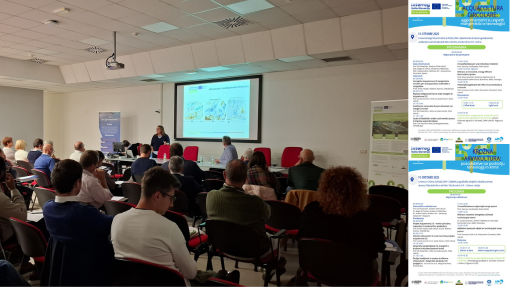
Udine, 10 October 2025 – A day of discussion and in-depth analysis on sustainable innovation in aquaculture was held at the University of Udine, bringing together experts, researchers, and industry professionals for the conference “Circular Aquaculture: Updates on Feed and Technological Aspects from the Acquainnova 2.0 and CircularRainbow Projects”, which featured eight speakers. In addition to 64 participants on site, about 30 people joined online, in a hybrid format.
The event, hosted in the Sala della Vite e del Vino of the Department of Agro-Food, Environmental and Animal Sciences (Di4A) of the University of Udine, was part of the training and dissemination activities of the Circular Rainbow project, which aims to introduce high-efficiency technological solutions into trout farming, such as digitalized RAS systems capable of optimizing water use, recovering effluents, and transforming them into energy or biomass, thereby reducing environmental impact. In parallel, the Acquainnova 2.0 project focuses on developing innovative feeds for circular aquaculture, assessing their economic and environmental sustainability.
After the opening remarks by Prof. Edi Piasentier, Head of the Department, and Dr. Andrea Fabris, Director of the Italian Fish Farmers Association (API), scientific presentations provided an updated overview of ongoing research, followed by questions and discussion with the audience.
First session
The first session was dedicated to the “circular” approach to feed formulation for trout and sea bream. Prof. Emilio Tibaldi introduced a new metric – the Material Circulatory Indicator – to measure the circularity of production processes. Prof. Roberto Pastres presented progress in feed sustainability analysis, highlighting the forthcoming use of the Product Environmental Footprint (PEF) to compare the environmental footprint of farmed fish under different formulations. Dr. Giulia Pascon and Prof. Lucilla Iacumin presented promising results regarding the growth performance, commercial yield, and nutritional and microbiological quality of sea bream and trout fed with circular feeds. Dr. Saida Favotto and Prof. Edi Piasentier shared the results of sensory tests, showing positive consumer acceptance of more sustainable fish products. Finally, Dr. Yari Vecchio and Margherita Masi presented a national feasibility study indicating that Italian consumers generally have a positive perception of fish farmed with circular feeds.
Second session
The second part of the conference was opened by Dr. Gloriana Cardinaletti, Scientific Coordinator of the Circular Rainbow project, who outlined the current state of trout farming in the cross-border area, emphasizing the need for a transition toward more resilient and sustainable production models. Through a multifactorial approach that integrates technological innovation, responsible water management, and circular bioeconomy principles, Circular Rainbow aims to demonstrate the feasibility of a new production paradigm where every effluent becomes a resource. A key element of the project is the Digital RAS, a real-time remote monitoring platform that allows continuous tracking of aquaculture environmental parameters and fish welfare, providing corrective feedback to improve efficiency and performance.The model is being tested in pilot plants in Italy and Slovenia, with the goal of developing operational and replicable guidelines for more efficient and low-impact trout farming.
Dr. Johan Johansen (Norwegian Institute of Bioeconomy Research) shared international experiences showing that sustainability is also achieved through energy efficiency. Low-energy systems (RASrace), already used in salmon farming, could provide a practical and transferable solution for trout production.Among the most innovative aspects of Circular Rainbow is the valorization of sludge and effluents from RAS systems as raw material for the production of biogas and new biomass. Dr. Alessandro Chiumenti illustrated how anaerobic digestion of effluents can produce renewable energy, with yields depending on the fish diet.
Finally, Prof. Francesca Tulli presented promising results on the use of black soldier fly (Hermetia illucens) larvae for the bioconversion of organic matter contained in effluents. The process generates biomass useful for other agro-industrial sectors and a residue that can be reused as soil amendment, establishing a virtuous cycle that reduces waste and restores value to materials.
In the afternoon, all participants joined a guided visit to the experimental facilities of the A. Servadei Agricultural Company of the University of Udine in Pagnacco (UD), where the new RAS plant, completed thanks to the Circular Rainbow project and co-financed by the Interreg Italy–Slovenia Programme, was officially inaugurated. The €80,000 investment represents the first digitalized RAS plant in the Triveneto region.
For more information, visit the photo gallery: conference and guided visit