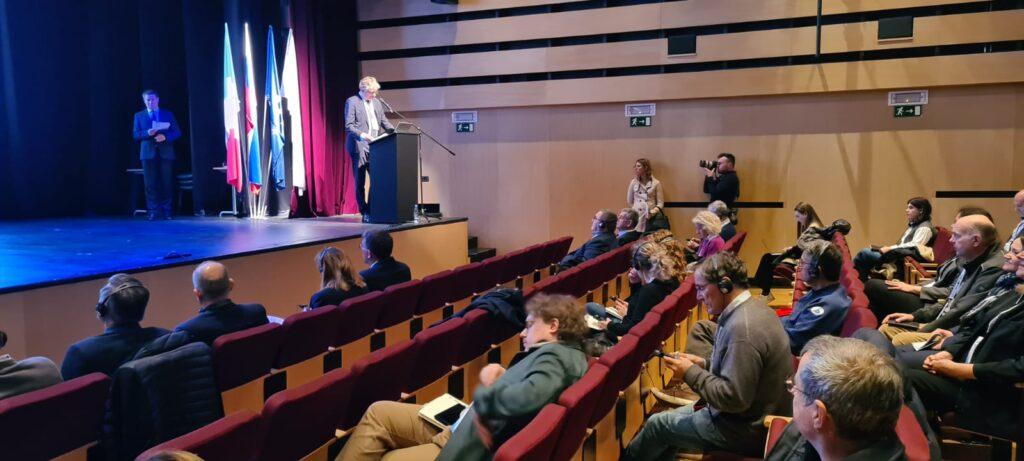
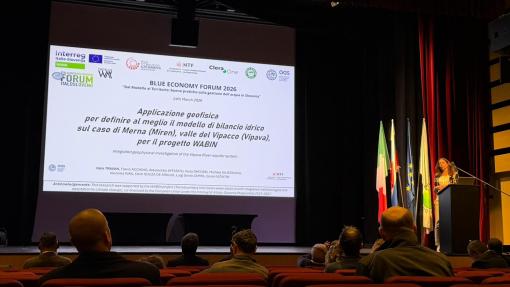
On 24 March 2026, the Blue Economy Forum 2026 took place in Ajdovščina (Aidussina), at the Hall of the First Slovenian Government. The event was a full day of study and exchange titled “From Model to Territory: Best Practices in Water Management in Slovenia”.
The event, organised within the Interreg WABIN project and co-funded by the Interreg VI-A Italy–Slovenia Programme, brought together institutions, experts, and water resource managers from Italy and Slovenia. It involved an Italian delegation of stakeholders and policymakers in a training-oriented and operational programme.
The initiative represented a concrete opportunity for dialogue between research and practical implementation, with a focus on comparing models and best practices for sustainable water management in a cross-border context. The session was moderated by Jurij Giacomelli, President of the Italian-Slovenian Forum.
From research to practice
The event was opened by the Italian Ambassador to Ljubljana, Giuseppe Cavagna, the Director for Water at the Slovenian Ministry of Natural Resources and Spatial Planning, Lidija Globevnik, the Mayor of Ajdovščina, Tadej Beočanin, and Diego Santaliana, B.U. Manager for Cooperation Projects at Polo Tecnologico Alto Adriatico.
In his speech, Santaliana presented the objectives of the WABIN project, which focuses on two main directions: developing a model for calculating the cross-border water balance and promoting greater awareness of sustainable water use among citizens and stakeholders.
During the morning session, innovative experiences and solutions were presented, including natural disaster management in Slovenia, the irrigation system of the Vipava Valley, and national methodologies for water balance calculation.
One of the key moments was the technical workshop on water impact calculation, during which the water balance model developed within WABIN and tested on the Mirna Valley case was presented. The aim is to transfer operational knowledge to stakeholders and make the model replicable in other territorial contexts.
This was followed by presentations of best practices in circular economy applied to water management, with particular attention to microplastics and river waste recovery.
In the afternoon, participants took part in a field visit to the Slano Blato site, an area of significant environmental and geomorphological interest, further strengthening the link between theoretical knowledge and direct observation.