The 7th Slovenian Geological Congress took place from Thursday, 1 October, to Saturday, 3 October. It was organised by the Karst Research Institute of the Research Centre of the Slovenian Academy of Sciences and Arts (ZRC SAZU) and the Slovenian Geological Society. This is a major event for Slovenia’s entire geological community, held every four years at a different location. This year, the Karst was chosen as the host region, and the scientific programme took place at Hotel Maestoso in Lipica.
The first two days were marked by scientific presentations and poster sessions, the exchange of knowledge and ideas, and engaging discussions among geologists.
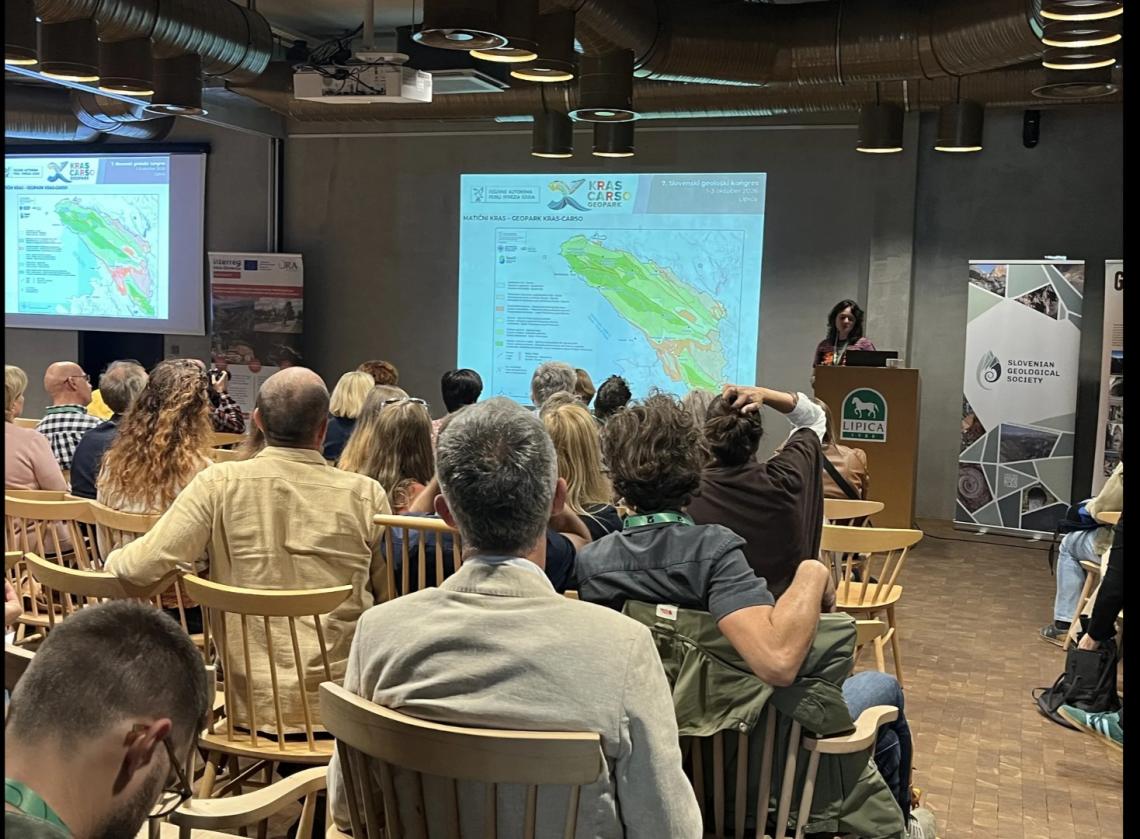
The plenary lecture on the first day was delivered by geologists Dr Bojan Otoničar, Dr Adrijan Košir and Dr Sara Bensi under the title “The Geology of the Karst and the Cross-Border Geopark”. The two male geologists presented historical and recent research into the geological formation of the Karst Plateau, while Dr Bensi discussed cross-border research cooperation, which led to the creation of a joint geological map. This map provides the basis for future educational and geotourism applications within the emerging cross-border geopark. In recent years, Interreg projects in this shared area have played a crucial role. One of the most recent initiatives is the KRAS-CARSO II project, which has enabled cooperation in several fields, including scientific and professional research, tourism promotion and education.
In the afternoon, participants took part in a technical visit to the Lipica I Quarry, operated by Marmor, Sežana d.d., followed by a visit to the Lipica Stud Farm.
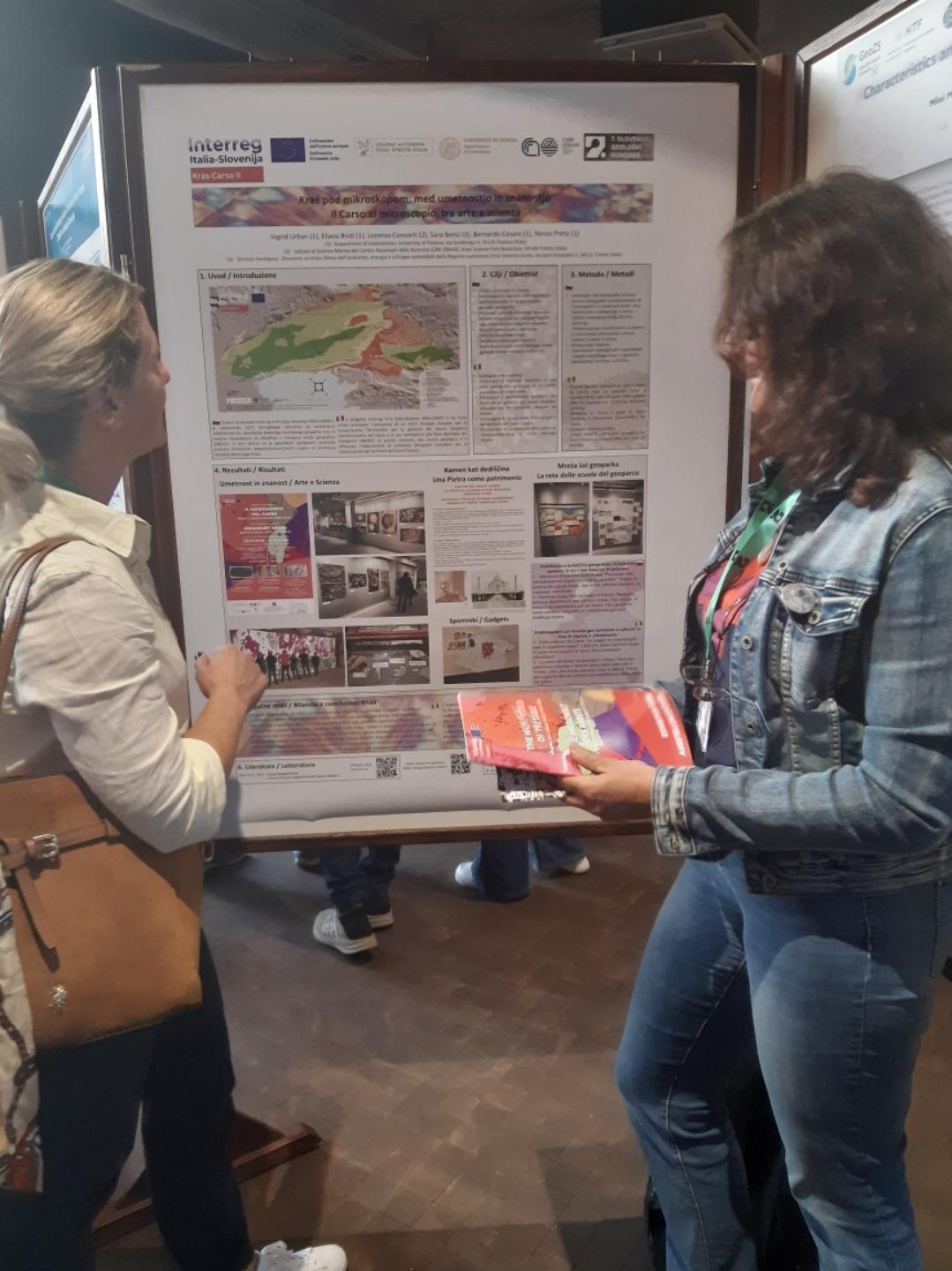
The second day began with an engaging plenary lecture entitled “Karstology on the Karst”, presented by geologists Dr Nadja Zupan Hajna and Dr Metka Petrič. The Kras region has been extensively studied over the centuries, and in recent years, the most significant karstological and hydrogeological research has been characterised by cooperation between institutions. As we know, the Reka–Timavo karst aquifer system is inherently transboundary, making joint cooperation essential for effective research.In the afternoon, awards were presented to the winners of the “Geology of the Karst” photography competition. We are proud that the photograph “Microworld of the Karst”, which features a magnified image of a thin section of rock found near the Rosandra Valley, won third place.
The photograph was produced as part of the KRAS-CARSO II project through collaboration between its partners: the University of Padua, CNR-ISMAR, the Geological Survey of Slovenia and the Geological Survey of Friuli Venezia Giulia.
The programme continued with the presentation of awards by the SKIAH Society, followed by the electoral assembly of the Slovenian Geological Society. After four years, Dr Astrid Švara’s term as president came to an end. As the congress’s lead organiser, she is also a partner in the Kras-Carso II project. The society’s presidency will now be taken over by Associate Professor Dr Petra Žvab Rožič from the Department of Geology at the Faculty of Natural Sciences and Engineering, University of Ljubljana. The day concluded with a society dinner organised by the Slovenian Geological Society (SGD) and SKIAH.
The third day was dedicated to a technical excursion. Participants visited the northern T1 portal at the construction site of the Second Track Divača–Koper railway line and then continued to Škocjan Caves Park, Slovenia. The congress thus concluded in one of Slovenia’s most remarkable karst landscapes and at one of the key geological sites of the Kras-Carso Geopark.