The meeting "Prevention of Soil Erosion and Loss of Fertility – Climate-Adapted Agricultural Practices" was held on Friday, March 6, at the Chamber of Crafts and Small Businesses in Ajdovščina (Slovenia). This meeting was part of the press tour organized as part of the European project Ero-STOP – Advanced and Sustainable Approaches to Soil Erosion Prevention, co-funded by the Interreg VI-A Italy-Slovenia program. The event brought together Italian and Slovenian researchers, technicians, farmers, and journalists to explore the project's findings and discuss strategies for preventing erosion in the cross-border area.
During the morning, the objectives and results achieved so far by Ero-STOP were presented, with a roundtable discussion among experts and a debate open to the public. The meeting also featured a bilingual information brochure titled "Protect the Land Where the Future Is Born / Zadržimo zemljo tam, kjer raste prihodnost" (Protecting the Land Where the Future Is Born). The brochure was created as part of the project to disseminate, in a simple and visual way, best practices for preventing soil erosion, particularly in agricultural areas. The document, explained by Vasja Juretič of the Nova Gorica Agricultural and Forestry Institute, offers practical guidelines for creating terraces, managing grass cover, and preventing landslides and erosion. The material is designed primarily for farmers and uses simple language and graphics to make the recommended techniques immediately understandable. These include the choice of grass mixtures suited to the soil, capable of enriching it with nitrogen while simultaneously absorbing water, improving soil stability.
As project leader Karmen Bizjak Bat (KGZ Nova Gorica) explained, in recent years, several areas between the Slovenian and Italian borders—including Zavino and Collio—have been affected by landslides and mudslides, a sign of growing soil vulnerability. The project therefore worked to develop an action plan that identifies the main problems facing the area and proposes intervention strategies, developed in part thanks to technical workshops held between Ajdovščina and Portogruaro. "We discussed and collected best practices for addressing erosion," she explained, "and also established a cross-border expert group that will continue to work on these issues even after the project's conclusion." The action plan developed by the project includes long-term objectives, including the creation of an erosion monitoring system and the collection of open data accessible to technicians and farmers who intend to implement land management interventions, such as new terracing. Another area of work involves improving the regulatory framework: according to experts, Slovenian legislation still has some gaps, particularly because it addresses erosion primarily in coastal areas or along waterways, while phenomena such as erosion from intense rainfall or wind are not specifically addressed.
According to Professor Janko Logar, soil erosion is a phenomenon that has become more evident in recent decades, partly due to climate change, changes in agricultural techniques, and the progressive abandonment of some rural areas. "Thirty years ago, erosion was less of a problem," he observed, "but today, climatic conditions and land management methods have changed." Water erosion, he explained, occurs when intense rainfall fails to infiltrate the soil and the water flows on the surface, carrying soil particles with it. "Vegetation is one of the main defense factors because it retains the soil and reduces the phenomenon." Landslides, however, are a different story. They involve larger masses of soil and multiple geological layers that slide along unstable surfaces, often due to rainfall or human intervention.
There are also cases of wind erosion, favored by the presence of the bora wind and by slopes devoid of vegetation, which facilitate the transport of the most fertile topsoil. Research activities also used advanced technological tools, such as drone surveys and field core sampling, to collect data useful for better understanding the erosive processes. "We cannot change rainfall or the nature of the soil," the professor added, "but we can intervene with technical measures, such as vegetation management or the creation of terraces, to reduce the effects of erosion."
The meeting also addressed the issue of soil fertility loss, a phenomenon closely linked to erosion. As speaker Anka Poženel explained in the morning, increasingly intense and frequent autumn rains, even in spring, are exacerbating erosion. Water erosion can take various forms: laminar—the most common—when thin layers of soil are gradually washed away by water; furrow-like, when water flow creates small channels; or deeper depressions. Even slopes with a minimal gradient, around 1%, can be affected.
The planners from the Civil Protection Department of the Municipality of Ajdovščina, involved in the remediation work in the municipality of Zavino, explained that the conversion of the area into a vineyard had altered the soil's drainage conditions, leaving the soil temporarily exposed and more vulnerable. "Within half an hour, a very heavy rain fell," they said, "and the soil, which had not yet stabilized, was eroded. The water and sediment flowed downstream, all the way to the village." The solution identified was the construction of a collector to act as a retention basin, capable of collecting material from the slopes and regulating the flow of water downstream without overloading the drainage system. The experts noted that the Zavino area is characterized by flysch, a geological formation with low water infiltration capacity that, when saturated, can behave like clay, encouraging soil slumping. For this reason, drainage infrastructure maintenance and the presence of vegetation are considered essential to preventing further erosion.
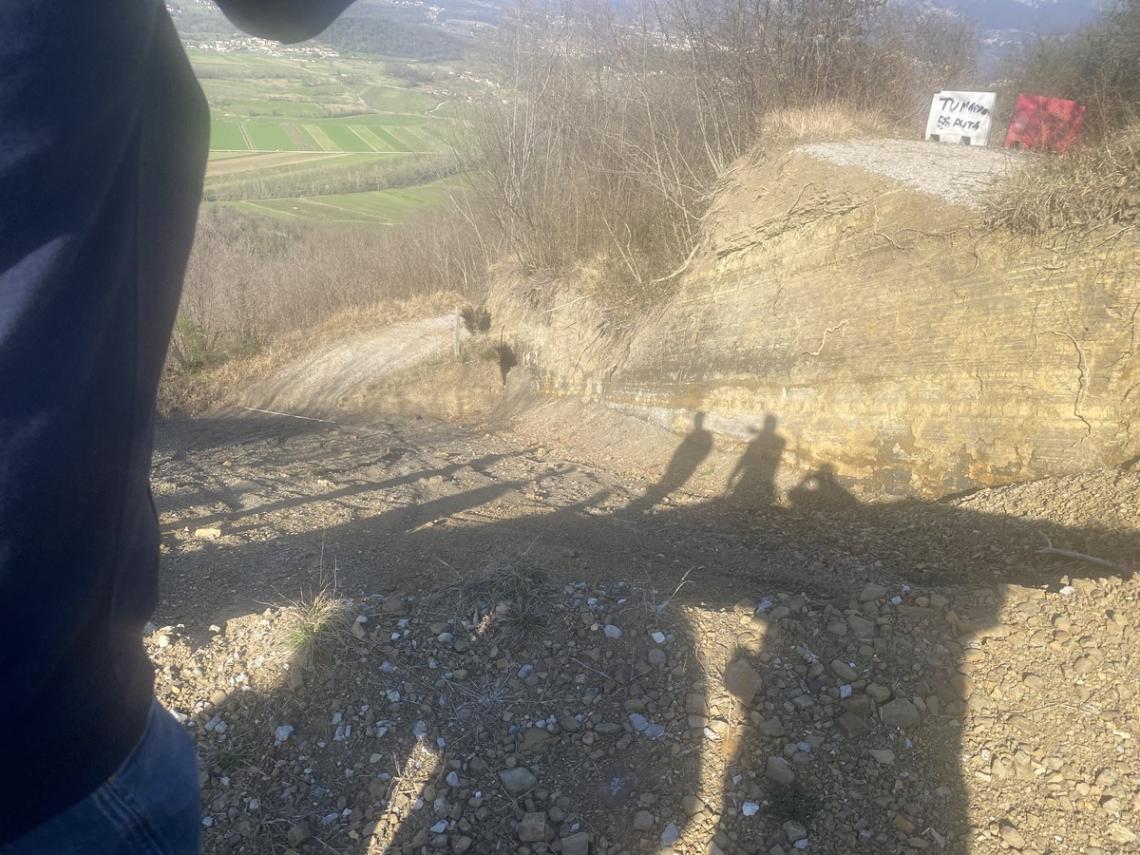
The day concluded with an inspection of the Vipava hills, not far from the Zavino vineyards, which have also recently been hit by intense weather events. On October 7, 2025, a violent storm dumped over 250 millimeters of rain in 72 hours, with peaks of 129 millimeters in just two hours, causing landslides, damage to agricultural land, and the destruction of several road infrastructures. Incidents like this, experts emphasized, demonstrate the urgent need to develop prevention and land-use planning tools capable of reducing erosion-related risks.
The Ero-STOP project will continue with a final conference scheduled for March 25 in Trieste, supported by the Ministry for Economic Development and the Ministry of Agriculture. International experts will also participate in the conference to discuss future prospects for cross-border cooperation in soil management and the prevention of hydrogeological instability.