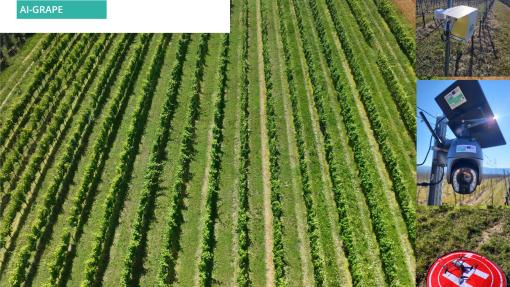
Field trial of the AI-GRAPE project in Bilje
How can sustainable approaches and new technologies contribute to more effective vineyard protection? Within the AI-GRAPE project, a field trial was conducted in a vineyard in Bilje to test the effectiveness of an orange oil-based product in controlling the American grapevine leafhopper (Scaphoideus titanus), one of the main vectors of grapevine diseases.
The objective of the research was to evaluate the potential of natural alternatives while collecting reliable data through smart monitoring systems to support the development of more sustainable viticulture.
How was the trial designed?
The experimental vineyard covered 1 hectare and consisted of 16 rows of vines. The vineyard was divided into two equal parts. In the first half, three treatments with a conventional product based on pyrethrin were carried out. In the second half, the first treatment was performed with the experimental orange oil-based product, followed by two additional treatments with the pyrethrin-based product.
All treatments were carried out at the same time, enabling an objective comparison of the results.
Monitoring pests with smart tools
The presence of the American grapevine leafhopper was monitored using an automated Trapview trap. In addition, six yellow sticky traps were installed in each treated section of the vineyard and were inspected and replaced every 14 days if necessary.
The monitoring results showed a very low presence of the pest. A few individuals were detected in the automated trap, while no significant catches were recorded on the sticky traps.
What do the results tell us?
Due to the low population of the American grapevine leafhopper at this location, the results cannot yet provide a definitive assessment of the effectiveness of the orange oil-based product. For this reason, the research will be repeated in areas where a higher pest presence is expected.
Nevertheless, the trial represents an important step forward in developing data-driven, digital, and sustainable approaches to vineyard protection.
Monitoring pests at other locations
Within the AI-GRAPE project, monitoring activities were also carried out regularly at other locations. In Bilje and Livadah, the American grapevine leafhopper was monitored, while in Škocjan the European grapevine moth (Lobesia botrana) was monitored.
The results showed a low population of the American grapevine leafhopper at both locations. In Škocjan, the population of the European grapevine moth was higher as expected, but due to unfavourable weather conditions and effective spraying, the damage was negligible.
Follow the next activities of the AI-GRAPE project
The AI-GRAPE project combines smart technologies, field measurements, and sustainable approaches with the aim of improving vineyard management.
👉 Follow us to discover how digital solutions are transforming viticulture.