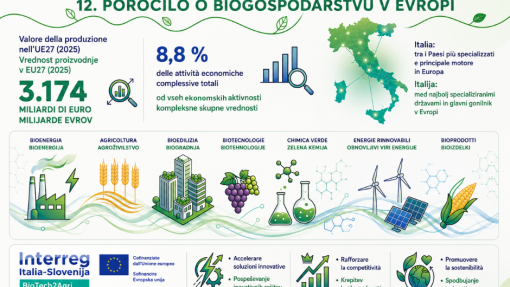
The 12th Report on the Bioeconomy in Europe confirms the increasingly strategic role of a sector that significantly contributes to economic growth and sustainability in the European Union. In 2025, the bioeconomy generated a production value of €3.174 trillion in EU27 countries, representing 8.8% of overall economic activities and providing employment for more than 17 million people. Italy remains among the most specialised European countries in this sector, with a production value of €433.3 billion and more than 2 million employees. Today, the bioeconomy accounts for around 10% of the national economy and 7.6% of total employment, driven mainly by the competitiveness of the agri-food value chain.
Innovation plays a central role in this scenario. The report highlights the presence of 707 innovative startups operating in the Italian bioeconomy, engaged in the development of bio-based materials, the valorisation of waste, the research of new food models and the creation of sustainable solutions for numerous production sectors. These figures confirm that research, technology transfer and collaboration between companies and innovation organisations are key elements to strengthen European competitiveness and support the transition towards more sustainable and circular production models.
These are the same challenges addressed by the BioTech2Agri project, which promotes biotechnological innovation applied to agri-food value chains, fostering connections among companies, research centres, clusters and innovation ecosystem stakeholders in the cross-border area between Italy and Slovenia. Launched in March 2024, the project has supported the development of dedicated services for SMEs, with the aim of strengthening innovation in agri-food value chains, promoting biotechnological applications with impacts in the nutraceutical, cosmetics and agritech sectors, and placing particular attention on the sustainable valorisation of biological resources, by-products and production waste – areas that currently represent some of the main development drivers of the European bioeconomy.
The results of the Report therefore confirm the growing importance of an economic model capable of combining innovation, sustainability and competitiveness, offering new opportunities for businesses and territories. In this context, initiatives such as BioTech2Agri contribute to turning the challenges of the ecological transition into concrete opportunities for growth, promoting the dissemination of knowledge, skills and innovative solutions for the benefit of SMEs in the Italy-Slovenia cooperation area.
To learn more about the topic, consult the 12th Report on the Bioeconomy in Europe.