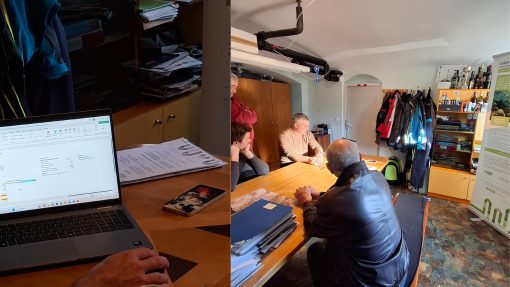
On Wednesday, 25 February 2026, the event “Circular Rainbow Lab – Consultation with the Slovenian fish farmers’ group” took place at Ribogojnica Mihovc fish farm in Kamnik, Slovenia, as part of the CIRCULAR RAINBOW project.
The Circular Rainbow Lab is a process of dialogue and cooperation involving fish farmers, researchers, experts and institutional representatives. Its aim is to identify practical solutions to support the trout farming sector in moving towards more sustainable, efficient and climate-resilient production models.
The meeting represented the consultation phase with the Slovenian fish farmers’ group, following an initial survey and the identification of farms interested in the transition. Its objective was to explore the opportunities and challenges associated with converting trout farms from traditional flow-through systems (FTS) to hybrid systems (HFS) and recirculating aquaculture systems (RAS), promoting a circular trout farming model that is environmentally and economically sustainable and capable of responding to the challenges posed by climate change.
The meeting brought together three Slovenian fish farmers interested in assessing the conversion of their facilities, together with representatives of KGZS – Zavod KR. Representatives of the Fisheries Sector of the Slovenian Ministry of Agriculture, Forestry and Food (MKGP) had also been invited, with the aim of fostering dialogue between industry operators and the competent institutions.
The meeting included a presentation of the objectives of the Circular Rainbow project and the main features of recirculating aquaculture systems (RAS), with particular attention to the technical, operational and economic aspects of the transition.
Miha Štular (KGZS Zavod Kranj) presented the techno-economic analyses developed individually for each fish farm, including estimates of rainbow trout production costs under the RAS scenario. These assessments enabled fish farmers to gain a better understanding of how technological changes could affect their cost structures and expected production costs.
Particular attention was devoted to the economic calculator developed within the project. This tool allows each fish farmer to enter farm-specific data – including production volumes, energy consumption, feed costs, labour and investment costs – and calculate key indicators of investment feasibility, such as the payback period, internal rate of return and net present value. As a practical example, a simulation was presented for Mihovc fish farm, based on an annual production scenario of 20 tonnes of trout.
The discussion addressed several operational and management aspects of the transition, including:
• Operating costs and investments. The main cost items were examined, including feed, energy, labour, maintenance and veterinary services, as well as the investments required for pumps, filtration systems, oxygenation, monitoring and alarm equipment.
• Energy consumption and renewable energy sources. The higher electricity demand of recirculating systems was highlighted, together with opportunities to cover part of this demand through photovoltaic installations integrated with the electricity grid.
• Digitalisation and monitoring. The importance of monitoring key parameters and digitally controlling production was emphasised as a means of improving farm management and ensuring greater stability of production processes.
• Economic assessment of investments. The importance of using realistic, farm-specific input data was highlighted as an essential condition for obtaining reliable estimates of costs and the economic sustainability of the transition.
The discussion with fish farmers highlighted that the transition to RAS requires a realistic assessment of costs, adequate production volumes and the gradual introduction of new technologies, taking into account the specific characteristics and needs of each facility.The meeting represented an important opportunity for the transfer of project knowledge and tools to the production sector, fostering dialogue between operators and institutions and providing fish farmers with practical information to assess opportunities for innovation. Some participants also expressed interest in continuing the exchange through further individual consultancy activities within the project.
The meeting was held entirely in Slovenian, as envisaged by the project, following the consultation organised in Italy on 13 February 2026 with the Italian fish farmers’ group.