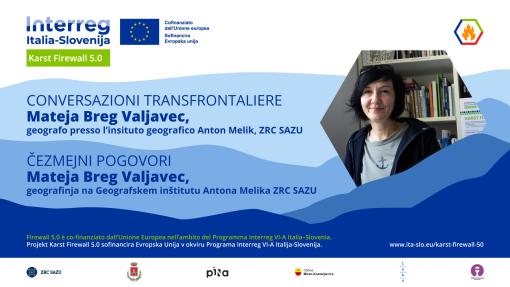
We sat down with Mateja Breg Valjavec, geographer and Head of the Department of Geographic Information Systems at the Anton Melik Geographical Institute (ZRC SAZU), to talk about her work on the Karst Firewall 5.0 project. With a background in Karst studies, geoinformatics, and environmental protection, she explains how scientific research, digital tools, and fieldwork come together to assess wildfire vulnerability in the cross-border Karst region, support decision-making, and translate data into concrete actions on the ground.
For the start, she talked us through the meaning of the Karst Firewall 5.0 project, explaining how the name refers both to the cross-border Karst region between Slovenia and Italy and to the dual concept of a “firewall” as a physical firebreak in the landscape and a digital protection system, with “5.0” highlighting the role of Industry 5.0, digitalization, and advanced technologies in reducing wildfire risk and supporting better prevention and decision-making.
What exactly is the role of the Anton Melik Geographical Institute in the project?
The Anton Melik Geographical Institute’s role in the project is to provide professional, research-based support by preparing expert materials and vulnerability maps, selecting pilot areas, and monitoring changes using drones and satellite imagery. This work supports management and decision-making in wildfire prevention and response. Within the consortium, the institute collaborates closely with municipalities, civil protection, the Forestry Institute, the Nova Gorica fire brigade, and other partners, with knowledge exchange and interdisciplinarity being key to the project’s success.
As a professional geographer and researcher, what professional knowledge do you bring to the project, and which methods and tools do you use?
As geographers and researchers, the team brings interdisciplinary expertise combining geography, biology, and botany, covering both ecosystem analysis and technical aspects such as GIS (Geographical Information System) and remote sensing. Our work includes cartography, field data collection, and monitoring post-fire ecosystem recovery using drones, multispectral and thermal cameras, and satellite imagery. All data is processed through advanced GIS and specialized software to support accurate analysis and fire risk assessment.
What are the values of cooperation and what are the challenges?
I have experience in cross-border collaboration between Slovenia and Croatia, and between Slovenia and Italy. Working with Italy can be more challenging because we often prepare texts in English and then translate them into Slovenian and Italian, but the benefits outweigh the challenges. Cross-border cooperation allows for more concrete, practical solutions, close partner interaction, and direct fieldwork, especially in historically interconnected border areas. I’m glad that collaboration continues seamlessly across these borders.
What is a concrete example for the work of a geographer in the institute or field?
At the institute, my work as a geographer is very diverse. I help design research, prepare project ideas, and secure funding, then carry out all project activities, from collecting current and historical data on the Karst landscape to fieldwork with measuring instruments, monitoring systems, and remote sensing analysis. No two days are alike - between fieldwork, office tasks, lab analysis, and meetings, the work is dynamic, creative, and constantly evolving.
What is the most exciting part for you in the project?
For me, the most exciting part of the project is fieldwork, especially on the 2022 fire site, which was unprecedented in Slovenia. Monitoring and tracking vegetation recovery across differently affected areas has been fascinating, seeing how quickly nature regenerates. At the same time, I find it compelling to study the causes of the fire’s spread and develop measures to protect settlements and ecosystems from future fires.
What are the concrete results that will arise from this project?
The most concrete results of the project will be measures and recommendations for interventions in the pilot area of Miren-Kostanjevica, showing which actions to implement and where, based on the landscape. If successful, these measures can be applied to other parts of the Karst or other regions in Slovenia and Italy. Forest managers, the Slovenian Forestry Institute, civil protection, and firefighters will benefit most, using the Karst Firewall platform for informed decision-making and fire response.
What is the potential for replicability?
I think if the measures proposed for the pilot area of the municipality are successful in the long term, other municipalities can replicate them. Word of mouth will spread and results can be applied in other areas, allowing for Karst fire protection.
What do you think is the awareness of the region regarding citizens and the public?
Our research shows that most fires in the Karst start near human-made elements like roads and railways, meaning human activity plays a major role in fire ignition. Climate change is making the region hotter and drier, increasing fire risks, so responsible behavior is essential. Following expert advice and proposed solutions can help protect ecosystems, reduce fire risk, and limit negative environmental impacts. Every individual can contribute by being aware of their actions and adapting behavior to live more in harmony with the environment.
In the Karst, resilience isn’t about reacting to fire, but preparing for it every day. It comes from careful management of forests and pastures, maintaining ecological balance, and using technology to catch early signs of danger. Detecting fires early protects people, communities, and infrastructure, while making interventions more efficient and effective. By linking individual actions, local communities, and institutions with the landscape, the project demonstrates that proactive, everyday prevention is the strongest defense against wildfire risk.
This interview is part of the series Cross-Border Conversations, which brings together voices from both sides of the Italy–Slovenia border. Through the lens of the Karst Firewall 5.0 project, the series highlights the knowledge, stories, and everyday realities of those working to strengthen resilience in a landscape increasingly shaped by climate change.