From Culture to Enterprise
Cross-Border Ideas to Enhance Territories and Pasolini’s paths
The 4P Project Ideas Competition
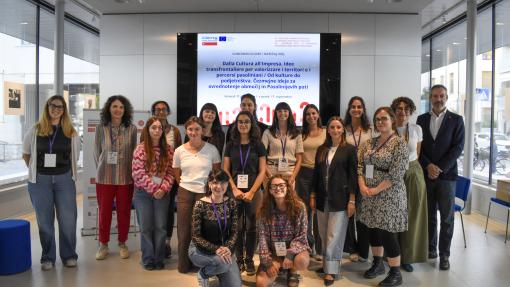
On Friday, September 11, 2026, the final day of the ideas competition “From Culture to Enterprise: Cross-Border Ideas to Enhance Territories and Pasolini’s Footsteps” took place in Pordenone. The initiative was held as part of 4P – Cross-Border Routes Discovering Pier Paolo Pasolini, a project aimed at enhancing Pasolini’s legacy through cultural routes between Italy and Slovenia.
The competition was launched to engage young people in developing new ways to experience and interpret the heritage linked to Pier Paolo Pasolini, connecting culture, tourism, local communities, and an entrepreneurial perspective. The goal was not merely to imagine new cultural products, but to reflect on how Pasolini’s legacy can continue to generate experiences, relationships, and opportunities for the region today.
Work began on September 7 with an online session dedicated to exploring Pasolini’s places and geography, identifying current and potential audiences, and developing buyer personas. The methodology presented to participants was inspired by Design Thinking, encouraging groups to start from people’s needs before defining a solution.
The sessions on September 11 brought this process into the project development phase. Divided into three groups, participants worked on refining their ideas, progressively focusing on target audiences, value propositions, implementation methods, economic sustainability, potential partners, and critical issues. The process concluded with the presentation of the three projects to the jury, followed by a collective feedback session.
Three proposals emerged, differing in approach and language: two decentralized cultural festivals and a technology-based project. This diversity allowed the jury to discuss not only the quality of the individual ideas but also the different possible ways to translate Pasolini’s heritage into a contemporary experience.
Group 1 – Decentralized Pasolini Days
Group Profile
The first group consisted of a pre-existing team from Culturit Venice, including Ilaria Marangoni, Selly Borgolotto, Mariam Ghattas, Micaela Ravanello, and Caterina Moro.
The participants mainly had backgrounds in culture, cultural heritage, the arts, and cultural management. The experience gained within Culturit also enabled the group to develop skills in conceiving, managing, and communicating cultural projects.
From Pasolini’s “Traces” to a Decentralized Event
The starting point of the proposal was intentionally simple: how well-known is the relationship between Pasolini and Friuli, really? The participants shared that they began with the provocative question, “But isn't Pasolini from Rome?”, recognizing the lack of awareness regarding the author’s Friulian roots and experiences as both a problem and a project opportunity.
From this emerged the concept of a “trace”—an element capable of connecting past and present. The proposal developed by the group consists of a series of decentralized Pasolini days, distributed across sites tied to the author’s life and work, designed to stimulate curiosity and rediscovery using a contemporary language.
The main hub would involve Pordenone and Casarsa della Delizia, extending to Idrija and other Slovenian locations. The chosen period is the month of March, coinciding with the anniversary of Pasolini’s birth, with a duration of approximately ten days.
The planned programming includes conferences, film screenings, and guided tours along existing paths, to be explored on foot or by bicycle. Added to these elements is a podcast, conceived not only as a promotional tool for the festival, but as an ongoing cultural product capable of remaining active throughout the year.
The podcast represents one of the most interesting elements of the proposal: as envisioned by the group, it would highlight both Pasolini and the contemporary territory, creating space for local associations and initiatives. It could thus become an evolving narrative archive, keeping the relationship alive between the project, the locations, and diverse audiences—including younger people and those who find it difficult to engage directly with Pasolini’s literary works.
Target Audience, Accessibility, and Organizational Model
The buyer persona used by the group was a young university student living away from home while working, characterized by limited financial resources. This choice led to an orientation toward a largely free event, with a small contribution of around 5 to 10 euros for guided tours, primarily intended to cover guide fees.
To make the decentralized nature of the event truly viable, the group identified mobility as a central issue. Alongside cycling and walking routes, the project included partnerships with local public transit companies, which are essential for connecting different locations and enabling participation for those without a car.
Key stakeholders identified include the Centro Studi Pier Paolo Pasolini, local associations, Italian and Slovenian universities (including those with translation and interpreting programs), and local economic operators. For organization, a six-month preparation period was envisioned, drawing primarily on existing facilities such as cinemas, theaters, auditoriums, and spaces provided by the Centro Studi.
The financial model remained less defined. Beyond potential small contributions from participants, the group suggested sponsorships, university collaborations, and involvement of regional operators, without offering a comprehensive cost estimate.
Strengths and Critical Issues
The proposal demonstrated a strong ability to connect cultural content, slow mobility, and the local territory without creating new infrastructure, leveraging existing paths and facilities instead.
However, the group recognized the risk of stepping into a market already crowded with cultural festivals and events. Their proposed solution was a sharper focus on Pasolini’s work—moving beyond a simple biographical narrative—and pre-testing certain elements: for instance, a pilot podcast episode could gauge public interest, while a trial event could test outreach to Slovenian audiences.
Group 2 – “Fireflies” (Lucciole)
Group Profile
The second group consisted of Federica Peressin, Elisa Chierroni, Martina Angela Porto, and Maria Elena De Conti. Unlike the first group, these participants registered individually and were formed into a team during the workshop process.
The group combined skills across culture and cultural heritage, communications, marketing, and territorial development. For example, Federica Peressin has a background in the conservation and management of cultural assets and activities, while Martina Angela Porto brings expertise in digital technologies and communications for creative industries.
The Problem of Dispersion
The second group also began by examining existing offerings. The issue identified was fragmentation: while many places, routes, and initiatives already offer ways to learn about Pasolini, they are geographically and temporally scattered, lacking a strong unifying thread to bring them together into a network.
This realization led to “Lucciole” (Fireflies), a decentralized festival designed as a crossroad between Casarsa, Pordenone, Idrija, and the broader Friulian and Slovenian regions.
The distinction proposed by the group is significant: not simply a festival about Pasolini, but a festival that uses Pasolini as a lens through which to examine contemporary society and explore relations between Italian and Slovenian territories. Cinema, literature, sociology, and anthropology thus become tools for driving debate, exploration, and dialogue.
An Identity Built Around “Fireflies”
One of the most developed aspects was the project’s identity. The name Lucciole directly evokes Pasolini’s famous commentary on the disappearance of fireflies, transforming it into a metaphor for something fragile that deserves to be observed and preserved.
The group designed a distinct visual identity that is adaptable across different territories and languages, turning multilingualism from a potential barrier into a core element of the event.
The proposal features a week of activities across the region: talks, outdoor and indoor film screenings, and experiential activities, featuring content that is in-depth yet accessible. A central objective is to steer Pasolini away from purely commemorative or nostalgic readings: each edition could explore a different theme, drawing on his thought to spark dialogue about modern society.
Audience and Community Engagement
The target persona is a young adult between 18 and 35 years old—curious and already aware of Pasolini, but lacking deep knowledge and disinclined toward cultural formats perceived as overly academic or intellectual.
This led to a focus on hands-on experiences and a participatory design approach that avoids treating residents merely as spectators. The group proposed a bottom-up model, involving local communities early in the planning phase to gather their needs, gather feedback, and minimize potential disruptions to daily life.
Financial Model
Compared to the first group, Lucciole provided an initial budget estimation. The projected budget is approximately €150,000, with a twelve-month development timeline.
The funding structure blends public and private resources. The group highlighted regional grants for culture and festivals, alongside partnerships with foundations, associations, and other stakeholders. A hybrid ticketing approach was proposed for attendees: free outdoor events combined with ticketed admission for select indoor or specialized activities.
Mobility was again highlighted as a crucial factor for a spread-out regional festival, calling for strategic partnerships with public transit operators. Meanwhile, communication was identified as a core success factor, to be evaluated using participation rates, website traffic, and engagement with QR codes on promotional materials.
Group 3 – PPP Archive
Group Profile
The third group was composed of Valentina Pizzali, Gerardo Salvatore, Valentina Borean, and Ivana Provenzano, bringing together diverse expertise across cultural heritage, tourism, research, digital media, and education.
Among the team members, Valentina Pizzali’s background spans cultural tourism management and art history, while Valentina Borean comes directly from the tourism sector, focusing on developing new itineraries, events, and territorial enhancement projects.
From Archive to Personal Experience
Unlike the other two groups, the third group chose not to develop a festival format, opting instead for a technology-driven solution.
The primary buyer persona is a high school literature teacher around thirty years old, interested in Pasolini's work as well as personal and identity-driven discovery. The group also envisioned a secondary audience: the teacher sharing the experience and materials directly with their teenage students.
Titled PPP Archive in the presentation, the proposal stems from the digital and documentary collection of the Centro Studi Pier Paolo Pasolini and the goal of making it more accessible.
The project involves installing interactive digital kiosks (totems) where visitors can explore the archive through a journey that is both educational and personal. The core experience was described as a "semantic-emotional" algorithm: starting with questions such as “What does Pasolini mean to you?”, the system matches user responses with archive texts, poetry, photos, and other materials, returning tailored content based on individual sensitivities.
The innovation lies in transforming the archive from a passive repository into an interactive medium for personal experience, linking Pasolini's world with the emotions, questions, and identity of the contemporary user.
An Initial Network: Casarsa, Pordenone, and Idrija
The pilot project envisions three installations located in Casarsa della Delizia, Pordenone, and Idrija, creating a physical connection between Italy and Slovenia. For Pordenone, the group highlighted the opportunity to align the installation with the city's journey toward Pordenone Italian Capital of Culture 2027.
The Centro Studi Pier Paolo Pasolini would play a central role as the holder of the archive materials. In response to questions following the presentation, the team identified schools, cultural associations, and municipal culture departments as key partners to promote the system's use.
Sustainability and Growth Potential
Initial totem production could be funded through public grants or private sponsors. The group proposed tracking real-world usage via specific KPIs and, if successful, developing revenue streams through temporary equipment rentals for external exhibitions and events.
Compared to the other proposals, PPP Archive delivers a more defined, self-contained product that is easily scalable to other contexts. However, it relies heavily on access to the Centro Studi archives and the selection of the physical delivery hardware.
Jury Evaluation
The proposals were evaluated by a jury composed of professionals from complementary backgrounds:
- Paola Montanari (Videe S.p.A.) – Audiovisual production
- Valeria Broggian (Servizi CGN S.r.l. Benefit Company) – Sustainable business
- Antonio Scuderi (Capitale Cultura Group) – Cultural innovation
- Demis Corvaglia (Mobile 3D S.r.l.) – Immersive technologies
- Stojan Pelko (Director of the Slovenian Cinematheque) – Cultural and cross-border relations
- Federico Ingargiola (Senior Vice President of Confcommercio Pordenone) – Business and regional development
Rather than simply naming a winner, the jury delivered a comprehensive review of all three proposals, highlighting strengths and potential avenues for future growth.
An initial feedback point applied to both festival concepts: the jury noted that Group 1 and Group 2 needed a stronger identity to stand out from the existing landscape of cultural festivals, conferences, and events. Specifically, they stressed the importance of creating a clearer personality and driving stronger emotional engagement.
Feedback on Group 1
The jury appreciated the focus on slow mobility, noting that exploring Pasolini’s sites on foot or by bike fits current tourism trends and takes advantage of existing cycle paths connecting Friuli Venezia Giulia and Slovenia. The jury highlighted this aspect as a key direction for further development.
The primary weakness identified was economic sustainability. Offering an almost entirely free event without a clear overall budget resulted in a model that felt underdeveloped.
Feedback on Group 2
For the “Lucciole” project, the jury praised the group’s effort to establish a distinct project identity. The name itself impressed the judges with its ability to evoke Pasolini while capturing themes of fragility, vitality, and youth.
Another key factor was community engagement. In an era where many initiatives shift online, the festival was valued as a physical space for people to gather and build connections.
The jury also commended the decision to give “Lucciole” a broader social and civic purpose—engaging with contemporary issues and addressing what is disappearing and worth preserving. They also valued the experiential elements, noting that direct experiences drive emotion and build deeper audience connections.
Feedback on Group 3
Regarding PPP Archive, the jury praised the technological innovation and personalized user experience. The semantic-emotional algorithm was highlighted as a compelling feature, delivering unique content to each visitor based on their personal responses.
However, the jury expressed reservations about using physical kiosks (totems), questioning their modern relevance and scalability, as expanding beyond the initial sites would require additional hardware installations. They suggested exploring more flexible, mobile-friendly formats in the future while preserving the interactive and personalized nature of the experience.
“Lucciole” Wins the Ideas Competition
The jury’s final deliberations centered on a fundamental core question: should priority be given to a highly personalized individual experience, or to a collective proposal that builds community?
This consideration guided the final decision.
The jury declared Group 2, with the project “Lucciole”, as the winner of the competition.
The proposal was selected for its ability to design a decentralized festival that goes beyond celebrating Pier Paolo Pasolini, using his thought as a lens to interpret the present day. The identity built around the "fireflies," the commitment to connecting regions and languages, the focus on community involvement, and the experiential approach made it the concept most aligned with the goals of the challenge.
The sense of community was the deciding factor: transforming Pasolini’s sites into spaces for gathering, dialogue, and participation outweighed the more individual focus of the technology-driven third proposal. As the jury summarized, “Lucciole” aligned most closely with the initial vision and objectives of the competition.
The event concluded not only with the selection of a winning project, but with three distinct interpretations of the same brief. The decentralized days of Group 1 highlighted the potential of slow mobility and physical connections between locations; “Lucciole” prioritized community, contemporary relevance, and experience; and PPP Archive explored how technology can foster a personal relationship with cultural heritage.
All three perspectives demonstrate how Pasolini’s legacy can be approached not as static history to be preserved, but as a living resource to interpret regions, create new cultural experiences, and engage with the present.