The Public Institute for Tourism Nova Gorica and the Vipava Valley is a partner in the cross-border project DATIS – Digital Pioneers of Inclusive Tourism, co-funded by the European Union under the Interreg Italy–Slovenia Programme 2021–2027. The project brings together tourism organisations, accessibility experts and organisations representing persons with various disabilities, with a clear objective: to improve the digital accessibility of tourism content and thus ensure equal access to information for all.
Today, digital tourism is often the first point of contact between a visitor and a destination. If websites, booking systems or other digital content are not accessible, users are excluded already at the information-search stage – before they even reach the destination. Digital accessibility is therefore not a niche topic, but a fundamental element of a high-quality, modern and competitive tourism offer.
In 2025, within the framework of the DATIS project, we carried out free digital accessibility analyses for 50 tourism providers from Nova Gorica and the Vipava Valley. The analyses showed that most providers do not exclude users intentionally, but primarily due to a lack of awareness of guidelines, standards and good practices. The average level of digital accessibility of the analysed Slovenian tourism websites is 37%, which means that more than 60% of basic accessibility elements are often missing or not functioning properly.
The most common issues include missing image descriptions (ALT text), the absence of captions in video content, insufficient colour contrast, difficulties using websites without a mouse, and unclear navigation. Such shortcomings have a direct impact on user experience, the number of enquiries and booking success rates.
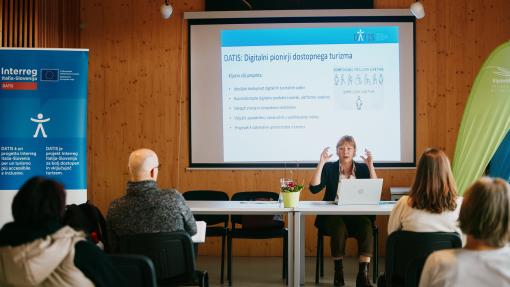
On 10 February 2026, a free workshop on digital accessibility was held at the Green Entry Centre Lijak, where, together with the project’s lead partner Beletrina, we presented tourism providers with the basic principles of digital accessibility, the results of the analyses, and practical, cost-effective solutions for improvement. Particular attention was also given to legal obligations, as the Accessibility of Products and Services for Persons with Disabilities Act, in force since June 2025, also applies to certain parts of the private sector.
The good news is that many improvements can be implemented quickly and with minimal cost: adding image descriptions, ensuring sufficient contrast between text and background, enabling keyboard navigation, including captions in videos, and providing a clear and well-structured content layout. What is understandable, clear and accessible for the most vulnerable user groups is better for everyone.
Digital accessibility is not a bureaucratic requirement, but an integral part of digital hospitality. If users cannot access information, they cannot become your guests.