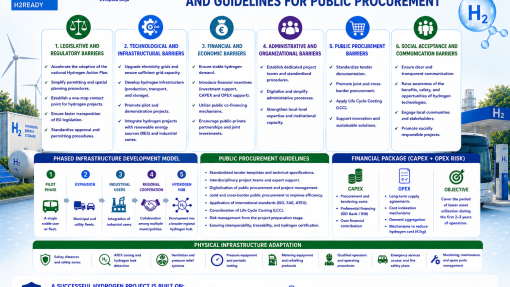
The H2READY project continues its activities in the field of integrating hydrogen technologies by providing important guidelines for more efficient planning and implementation of hydrogen projects. The document offers municipalities support in overcoming legislative, infrastructural, financial, and organizational challenges, while also presenting concrete recommendations for the development of sustainable hydrogen infrastructure.
Among the key recommendations is the early involvement of all relevant permitting authorities and the preparation of a clear regulatory framework that includes spatial planning, environmental procedures, fire safety, and connection to the electricity grid. In the field of infrastructure, the guidelines recommend the development of local hydrogen hubs in industrial zones, logistics centers, and public fleets, as this model reduces costs and increases the efficiency of infrastructure use.
An important emphasis is also placed on the phased development of projects. Municipalities are encouraged to implement projects gradually – from pilot users and public fleets to broader regional integration. The recommendations warn that without stable long-term hydrogen demand, many projects can quickly become financially unsustainable. Therefore, the guidelines advocate careful financial planning and the combination of various funding sources.
The guidelines will significantly contribute to the more effective implementation of hydrogen technologies by enabling municipalities to better plan projects, reduce risks, and accelerate permitting procedures. At the same time, they emphasize the importance of strengthening the competencies of employees in public administration, as the lack of specialized knowledge often represents one of the key obstacles in carrying out complex energy and public procurement procedures. Therefore, the recommendations include greater standardization of procedures, harmonization of documentation, the preparation of clear process protocols, and the use of pre-prepared templates and digital solutions that enable municipalities to implement projects more efficiently while ensuring greater legal and organizational security. In this way, the guidelines will also contribute to the greater financial sustainability of projects, the coordinated development of infrastructure, and increased public trust in hydrogen as one of the key elements of the green transition.