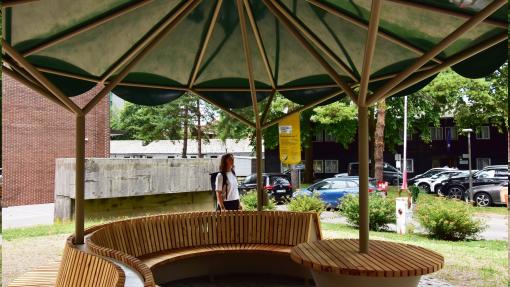
In the park next to the Gynaecology Clinic of the Ljubljana University Medical Centre, a new Climate Shelter – a shaded pavilion – was officially opened. It provides patients, their families, visitors and healthcare staff with a pleasant place to rest and seek relief during increasingly frequent heatwaves.
Well-designed green spaces play an important role in helping cities adapt to climate change. In healthcare settings, they reduce heat stress, improve the well-being of patients and staff, and create a more pleasant environment for recovery and work.
The area of the Ljubljana University Medical Centre is among the most heat-exposed parts of the city, as it is located within a pronounced urban heat island. This poses a particular challenge for patients, older adults, pregnant women, young children and other vulnerable groups who need to access healthcare services even during the hottest days. The Climate Shelter therefore represents an important step towards creating a safer and more comfortable environment for everyone using the hospital campus.
The pavilion was developed through a collaboration between the Ljubljana University Medical Centre and the urban planning studio Prostorož as a pilot solution for adapting to extreme heat. It demonstrates how relatively simple interventions can transform existing public spaces into welcoming, accessible and safe environments for all users.
At the opening ceremony, the Director General of the Ljubljana University Medical Centre, Associate Professor Marko Jug, MD, emphasised that the Medical Centre is committed to creating an environment where patients, their families and staff can feel as comfortable as possible. According to him, every newly improved public space represents an important contribution to the well-being of everyone using the hospital campus.
Zala Velkavrh from the urban planning studio Prostorož explained that the pavilion serves as a pilot Climate Shelter. Measurements showed that the maximum temperature recorded within the pavilion area was approximately 3°C lower than the highest temperature measured at the most heat-exposed locations around the Medical Centre. She stressed that the pavilion is not only a place to cool down, but also a reminder of the importance of creating and preserving high-quality green public spaces that can make cities more resilient to increasingly frequent heatwaves.