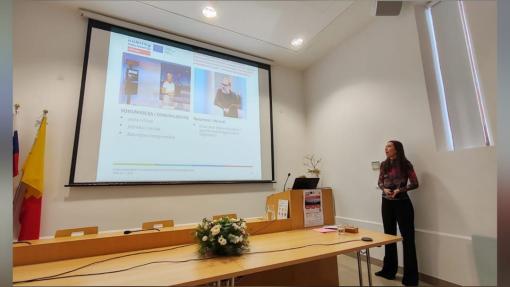
The training for tourist guides and guide candidates was successfully carried out within the framework of the Interreg KAŠTellieri project, whose main objective is the preservation, research, interpretation and promotion of the prehistoric cultural heritage of hillforts (gradišča/kaštelirji), as well as strengthening their role in the sustainable development of cross-border tourism between Slovenia and Italy.
The purpose of the training was to upgrade the knowledge and competencies of tourist guides and guide candidates for the professional, interpretative and visitor-oriented presentation of prehistoric heritage, particularly the way of life during the Bronze and Iron Ages. The activity contributed to improving the quality of tourism services, strengthening sustainable and inclusive approaches to tourism, and fostering cross-border cooperation among experts and stakeholders in the fields of culture and tourism.
The training consisted of four sessions, held on 26 January, 27 January, 3 February and 4 February, and took place in the cross-border area of Slovenia/Italy. The theoretical part was conducted at the Peace Memorial in Cerje, while the final day was dedicated to a professional cross-border field excursion, including visits to prehistoric hillforts and museum heritage sites. Guides from both the Slovenian and Italian sides participated in the training. The programme was delivered bilingually (Slovenian and Italian), with interpretation provided, ensuring equal participation of all attendees.
The invitation to the free training was published on the KAŠTellieri project website and disseminated through the communication channels of all project partners. Due to high interest, online participation via the ZOOM platform was additionally made available, thereby increasing accessibility and expanding the reach to the target group.
The training programme was designed in a comprehensive manner and included both general and specialised content. The first part focused on refreshing and upgrading the core competencies of tourist guides, with emphasis on high-quality heritage interpretation, contemporary guiding methods, digital transformation, sustainable and accessible tourism, working with vulnerable groups, as well as safety and first aid. Renowned experts from various fields were invited to contribute, including Mateja Rosa, Mateja Kregar Gliha, Bogdan Macarol, Dr Iztok Bončina, MA Astrid Prašnikar, Božena Peterlin, Boris Šega and Anja Sedevčič Lasič.
The second part of the training focused on in-depth professional and archaeological content related to prehistory and hillforts. Lectures were delivered by experts from Slovenian and Italian institutions, including Uroš Jelenovič, Assoc. Prof. Dr Manca Vinazza, Dr Federico Bernardini, Polona Janežič, Patricija Bratina and Dr Maša Saccara, who presented current research, methodologies and approaches to the interpretation of archaeological heritage.
The acquired theoretical knowledge was further reinforced through a professional field excursion, enabling participants to engage directly with the heritage and practically test interpretative approaches. Site visits were guided by expert archaeologists: the Grmača hillfort was presented by Patricija Bratina (Institute for the Protection of Cultural Heritage of Slovenia, Nova Gorica Regional Unit); the Debela griža (Volčji Grad) hillfort was guided by Assoc. Prof. Dr Manca Vinazza (University of Ljubljana, Faculty of Arts, Department of Archaeology); and the visit to the Elerji hillfort and the Civic Archaeological Museum in Muggia was professionally led by Prof. Dr Paolo Paronuzzi (University of Udine). This direct, on-site transfer of knowledge enabled participants to gain an in-depth understanding of the spatial context, archaeological remains and appropriate methods of presenting them to visitors.
On average, 25 participants attended the training in person each day, while at least 5 additional participants followed the programme daily via digital platforms, confirming strong interest from the target group and the broader reach of the activity. Detailed attendance lists for each day are attached to this report as proof of implementation.
Lecturers and experts from both sides of the border were involved in the implementation, further strengthening cross-border cooperation, knowledge exchange and a shared understanding of heritage as a connecting element of the area. Upon completion, participants received certificates of attendance, confirming their professional competence for the interpretation of hillfort heritage (gradišča/kaštelirji).
The activity fully met the planned objectives and indicators and significantly contributed to the sustainability of the KAŠTellieri project results, as well as to the development of high-quality, inclusive and sustainable cultural tourism in the cross-border area.