The ERO-Stop project concludes today, a two-year collaboration between diverse partners from Italy and Slovenia with a common goal: managing erosion processes in agricultural land. Italy and Slovenia are among the European countries most exposed to the risk of erosion. The causes are partly linked to the morphology of the land and the geological structure of the soil, partly to changing rainfall patterns, and, last but not least, to human intervention through land transformation and cultivation techniques.
Interdisciplinary projects are always challenging, as they require, first and foremost, the ability to listen and understand one another. It is necessary to understand and embrace the working methods of different disciplines and be aware of the regulatory specificities of the various fields. Learning from one another allows us to identify synergies between the partners' expertise and to chart new operational prospects. ERO-Stop was precisely such a project. We conclude with the knowledge that we have made concrete steps in some areas and, in others (for example, in terms of regulation), have at least indicated the direction of necessary future developments. We are enriched with knowledge that will contribute to making agricultural soils more resistant to erosion, as well as with long-lasting professional relationships.
As researchers, we are particularly motivated by the search for new approaches and possibilities in addressing scientific challenges. In an age of numerous technological opportunities, research sometimes resembles a building block game: integrating data obtained from different measurement methods, combined with IT tools, to produce a useful picture for the end user.
The Slovenian partners analyzed erosion resistance in three pilot vineyards, differing in age (vegetation cover and soil compaction), slope, size, and morphological complexity. Data on soil morphology were acquired through highly precise drone surveys, soil properties through laboratory analysis of soil samples, while water infiltration capacity was assessed through field measurements.
The first numerical simulations of erosion processes were performed using the established RUSLE (Revised Universal Soil Loss Equation) method, an empirical approach aimed at estimating soil erosion susceptibility. However, this method does not take into account local aspects such as preferential flow paths. Subsequently, the SIMWE (SIMulated Water Erosion) method, based on the continuity equations of water flow and sediment transport, was also applied. It emerged that, although this method requires some parameters that are difficult to determine and therefore does not yet allow for a fully reliable estimate of the amount of erosion, it does represent the flow paths of water and sediment very effectively. This information is directly applicable to drainage planning.
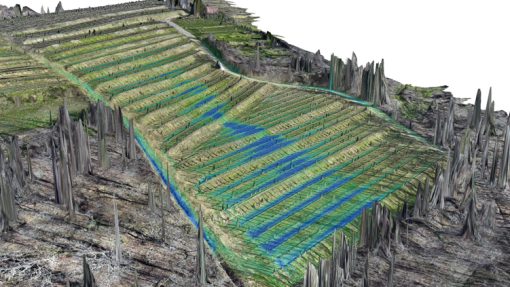
Both methods were implemented in a GIS environment, allowing for a clear and intuitive representation of the results and the identification of the points most exposed to erosion risk. The images shown show the height of the water blade calculated during a heavy rainfall event (100 mm/h) in the vineyards of Plače, Zavino, and Velike Žablje.
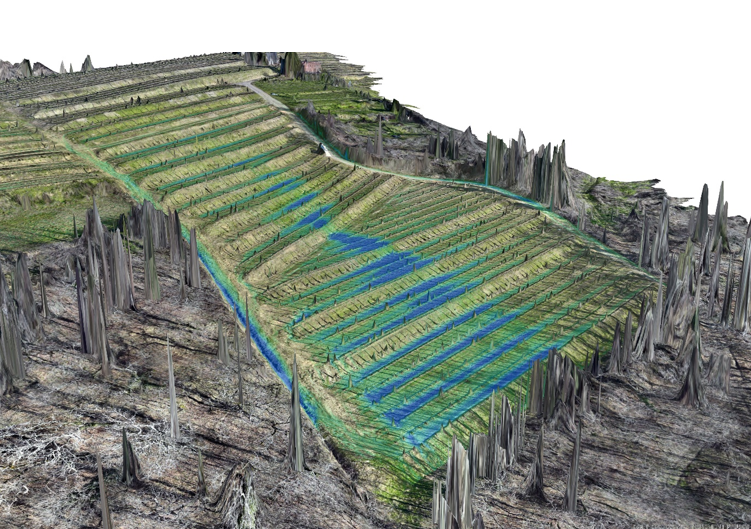
Figure 1: Numerical simulation of the water blade height during an extreme precipitation event in the Plače vineyard
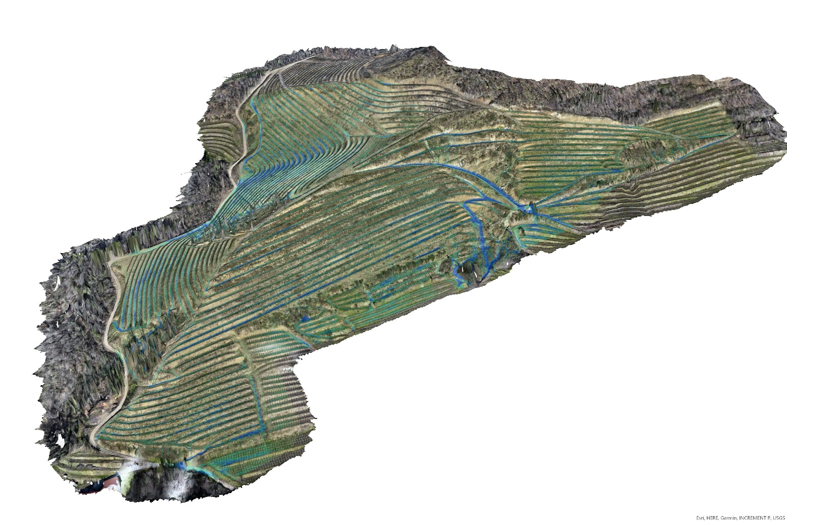
Figure 2: Numerical simulation of the water blade height during an extreme precipitation event in the Zavino vineyard
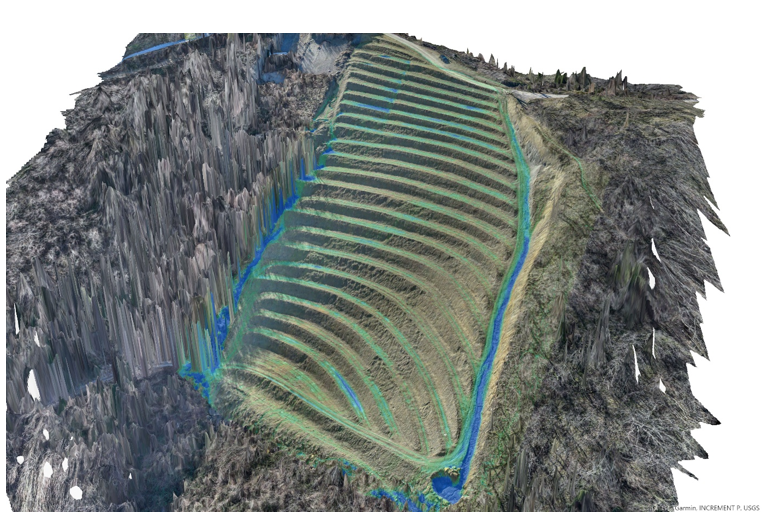
Figure 3: Numerical simulation of the water blade height during an extreme precipitation event in the Velike Žablje vineyard