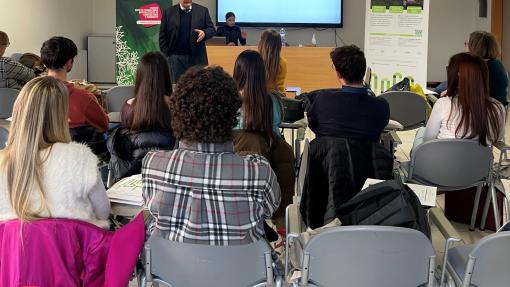
The series of free workshops organised by the DAIRY+ project has successfully concluded. The initiative aimed to transfer knowledge to dairy supply chain operators on how to transform by-products – especially whey – from waste into an economic and environmental resource.
WHY THESE WORKSHOPS?
The processing of milk into cheese and other dairy products generates by-products – such as whey, buttermilk and brine – which, if properly managed, can become valuable resources for developing new products, reducing waste and creating economic and environmental value.
The goal of the training cycle was clear: to promote knowledge transfer between the scientific community, businesses and institutions, and to encourage a more sustainable and innovative approach to managing these by-products.
FOUR SESSIONS BETWEEN SEPTEMBER AND NOVEMBER
The cycle consisted of four sessions, held both in person and online to ensure maximum accessibility for sector operators:
1. What should you pay attention to when managing by-products?
📅 24 September 2025 – Online workshop
The Istituto Zooprofilattico Sperimentale delle Venezie explored topics related to safety and hygiene in by-product management, focusing on emerging pathogens and regulations, with a particular emphasis on whey.
2. What innovative solutions can you apply to your by-products?
📅 29 October 2025 – In-person workshop at LARA (Udine)
The Department of Agricultural, Environmental and Animal Sciences of the University of Udine presented research on whey recovery for new food products, including a practical demonstration of the pilot plant at the Agri-Food Research Laboratory (LARA).
3. How can you best enhance the value of innovative products obtained?
📅 12 November 2025 – Hybrid workshop (CEFAP Codroipo + online)
Experts engaged by the Agrifood & Bioeconomy FVG Foundation explained what nutritional claims and novel foods are, the related regulatory requirements and the advantages for companies.
4. What are the market trends and support opportunities?
📅 26 November 2025 – Hybrid workshop (CEFAP Codroipo + online)
The session focused on market demand for products with nutritional claims and novel foods, along with available funding opportunities for innovative investments.
WHO PARTICIPATED
The cycle involved stakeholders from different fields:
• Dairy processing companies
• Farmers
• Processors and food technologists
• Food safety professionals
• Students and researchers interested in the circular economy in the agri-food sector
Speakers and experts: Massimo Marino, Stefania Feltrin (CeFAP FVG), Sonia Calligaris, Afro Ambanelli, Federico Nassivera, Paolo Rocchi, Elisabetta Bortoluzzi.
FROM THEORETICAL KNOWLEDGE TO PRACTICAL APPLICATION
The sessions combined scientific insights, regulatory updates, practical demonstrations (such as the visit to the LARA pilot plant), and market analyses. This training approach offered participants tools that they could immediately apply in their production environments, also thanks to the Good Practices Manual developed by the DAIRY+ project.
A STEP TOWARDS THE CIRCULAR ECONOMY
The workshop cycle is a key component of the DAIRY+ strategy: creating a shared knowledge network between Italy and Slovenia, supporting companies in transitioning to more sustainable production models, reducing waste and opening new market opportunities.
The participation and exchange during the events demonstrate the sector’s concrete interest. The challenge now is to translate the knowledge acquired into daily action.
TOOLS FOR CHANGE ARE READY
The DAIRY+ project has laid the foundations for a tangible transformation of the supply chain: a functioning pilot plant at LARA in Udine, a Good Practices Manual with replicable solutions and a training path that has transferred technical, regulatory and market knowledge to sector operators.
With project completion expected in April 2025, DAIRY+ will continue to release materials and results to support companies that wish to innovate, reduce waste and access new markets in the valorisation of dairy by-products.
The cross-border supply chain now has concrete tools to build a more sustainable and competitive future.