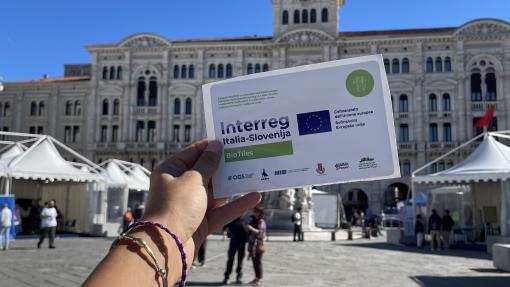
Three days of meetings, workshops and exhibition stands filled the centre of Trieste during the fifteenth edition of Trieste Next, the scientific research festival, which came to an end on Sunday, 27 September. This year’s theme, “The Shape of Thought”, brought together fields including neuroscience, artificial intelligence, health and the environment. More than 300 scientists took part in the festival, with dozens of exhibition spaces open to the public. Among them was the stand of OGS, the National Institute of Oceanography and Applied Geophysics and lead partner of the BioTiles project, where festival visitors had the opportunity to discover more about the project.
The stand was designed to be highly interactive, allowing visitors to touch and explore the materials directly. On the table, visitors could examine a tile made from biosubstrate and coconut fibres. They could also learn how a tile is produced from lagoon sediments and coconut fibres and try making one themselves, following the process step by step. It was a simple and hands-on way to understand that behind a research project there are concrete materials and practical processes that are often much closer to our everyday lives than we might imagine.
For an even closer look, a microscope with tile samples was also available, allowing visitors to observe the material at a scale that cannot be seen with the naked eye.
There was also plenty of fun. The lagoon-themed crossword invited children and adults to test their knowledge of the lagoon ecosystem between the various festival events.
The BioTiles project brings together a partnership of six Italian and Slovenian organisations: alongside OGS, the National Institute of Biology of Slovenia, the DOPPS Bird Conservation Society, Strunjan Landscape Park, Mimma Dreams APS and the Municipality of Grado. The project does not take place solely in the laboratory. Over the past few months, activities have included the kick-off meeting at OGS, training days in Trieste and Koper, the identification of experimental sites and, on 10 July, the first public field trip along the Stella River and in the Marano Lagoon.
The project will deliver concrete results: a graphical representation of the sediment erosion and deposition model, an operational protocol that can also be replicated in other transitional environments within the programme area, and the establishment of a lagoon HUB bringing together currently fragmented knowledge on biodiversity loss. All of this will be supported by a participatory process involving public authorities, associations, stakeholders and local communities, with the aim of developing shared guidelines for the sustainable management of lagoons.
Trieste Next was a valuable opportunity to present the BioTiles project beyond the laboratory and engage with a broad and curious audience. The project will continue until May 2027, with pilot actions being implemented at demonstration sites and the development of the lagoon biodiversity HUB.