First Workshop of the SANITAS Project – Cross-border Stakeholder Consultation
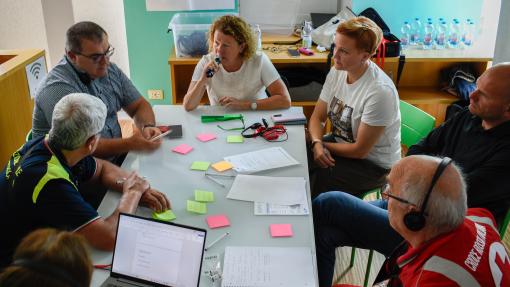
The first workshop of the SANITAS project, which took place on the 04.06.2026 at GO! Center, Gorizia, marked an important step in the process of developing a shared cross-border emergency healthcare protocol between Italy and Slovenia.
The meeting brought together key stakeholders from both sides of the border, including the Italian Red Cross, GENG, ZD Nova Gorica, GECT GO, the Civil Protection of Gorizia, ZD Tolmin, ZD Ajdovščina, VDC Nova Gorica, the Municipality of Ajdovščina, and ASUGI.
The main objective of the workshop was to gather the experiences, operational practices, and identified challenges of the involved stakeholders in order to use them as guiding elements for the development of a common cross-border protocol.
During the discussions, participants highlighted a series of critical issues related to two main emergency scenarios.
In the context of heatwave emergencies, key challenges included differences in public warning systems between Italy and Slovenia, with Italy relying on SMS-based alert systems while similar functionalities in Slovenia are still under development. Additional concerns were related to the concentration of emergency interventions during morning and evening hours, potential overload of energy systems, continuity of hospital services, limitations on the use of cooling systems in public buildings, and increased risks for vulnerable groups such as the elderly and individuals without access to adequate cooling. Participants also highlighted risks linked to wildfires, including possible damage to water supply systems and cross-border limitations in water distribution infrastructure.
In the flood emergency scenario, stakeholders underlined significant operational and legal barriers in cross-border rescue operations. These included the lack of formal agreements regulating cross-border patient transport, reliance on informal arrangements between operators, uncertainty regarding the transport and referral of patients to the nearest appropriate healthcare facility, and communication delays between emergency coordination centres requiring multi-level administrative chains. Additional issues concerned limited knowledge of procedures across borders, as well as linguistic, legal, bureaucratic, and insurance-related barriers.
A dedicated second workshop will take place on 18 June 2026 in Nova Gorica. This meeting will focus on the further analysis and validation of the identified challenges, with the aim of defining concrete operational solutions and priority actions for improving cross-border emergency coordination and interoperability between the two healthcare systems.
In the second half of 2026, a final roundtable with all stakeholders and relevant authorities will be organised in order to consolidate the contributions and define the content of the cross-border emergency healthcare protocol.
We look forward to welcoming you to the second workshop:
Thursday, 18 June 2026
9:30 – 12:30
X-center
Delpinova 20, Nova Gorica