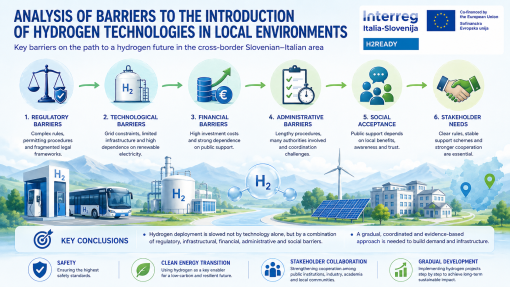
Within the H2READY project, a comprehensive analysis of the regulatory, technological, infrastructural, financial, administrative, and social barriers to the deployment of hydrogen technologies in the Slovenia–Italy cross-border area has been prepared. The document provides an important professional basis for planning future hydrogen projects and supporting municipalities in their transition towards a low-carbon society.
The analysis compares the situations in Slovenia and Italy and concludes that the main barriers are not related to the technology itself, but rather to an incomplete regulatory framework, lengthy permitting and spatial planning procedures, insufficient infrastructure, and high investment costs. Additional challenges include adapting electricity and gas networks, certifying renewable hydrogen, and ensuring stable hydrogen demand.
The document highlights that hydrogen technologies are already largely mature; however, their wider deployment is limited primarily by economic, administrative, and social factors. The successful development of the hydrogen economy will therefore require close cooperation between public authorities, industry, and energy stakeholders, together with the gradual establishment of a supportive regulatory and investment environment. Particular emphasis is placed on developing local projects in industry, transport, and logistics, where stable hydrogen demand and greater economic viability can be achieved.
The analysis represents an important milestone for the further implementation of the H2READY project and will support municipalities in integrating hydrogen technologies into local development strategies while contributing to the objectives of the green transition.