At Ljudska univerza Ajdovščina, an adult education centre in Slovenia, we are developing an accessibility strategy for cultural organisations and would like to include examples of good practice from Slovenia. We invite libraries, museums, galleries, theatres, cultural centres, cultural associations and other cultural institutions to send us a short description of their good practice. Adult education providers, non-governmental organisations and others who have developed solutions for more accessible culture together with cultural institutions are also welcome to contribute.
We are developing the strategy together with our partners VeGAL (Italy) and the Municipality of Vipava, as part of the project BEroots (Between Rivers and Lagoons: Artistic Routes), co-funded by the European Union under the Interreg VI-A Italy-Slovenia Programme. The project examines how cultural organisations in the Goriška region (Slovenia) and the Veneto region (Italy) make their content, programmes and spaces accessible. We focus in particular on persons with disabilities and vulnerable groups, including older people, migrants and speakers of other languages, people with low levels of education or literacy, and families with young children. Based on questionnaires for cultural organisations and visitors and on focus groups, we are preparing a joint cross-border accessibility strategy. It will offer cultural organisations recommendations and concrete measures for a more inclusive cultural offer.
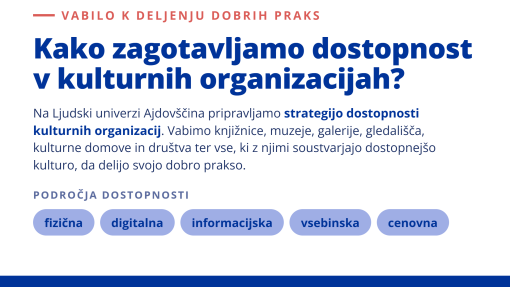
We understand accessibility as a set of interconnected areas. Physical accessibility covers adaptations of spaces and routes, such as step-free access, lifts, accessible toilets or tactile floor guidance. Digital accessibility refers to websites, applications and digital materials that can also be used by deaf, blind and partially sighted people and by persons with psychosocial disabilities. Informational accessibility means clear and understandable information about programmes and visits, for example texts in plain language, easy-to-read materials or information in several languages. Content accessibility includes adapted programmes and different ways of experiencing content, such as guided tours in Slovenian Sign Language, audio description, tactile reproductions, multisensory experiences or programmes co-created with vulnerable groups. Financial accessibility includes reduced or free admission and other measures that lower financial barriers to participation. We also welcome practices that combine several areas or do not fit this classification.
Please send a description of your good practice, no longer than one page, to info@lu-ajdovscina.si by Monday, 5 October 2026. In the description, please include the name of your organisation and a contact person, the title of the practice and the area of accessibility it addresses. Please also describe the target group, what you did, when and with whom, and what results or feedback from participants you received. If available, add a link to further information. Please also let us know whether you agree that your practice may be presented in the strategy under your organisation's name. The good practices we receive will be included in the accessibility strategy and will thus contribute to the exchange of knowledge between organisations. Smaller, local solutions that have proven effective in practice are also valuable.
More about the project: https://www.ita-slo.eu/en/beroots
Ljudska univerza Ajdovščina