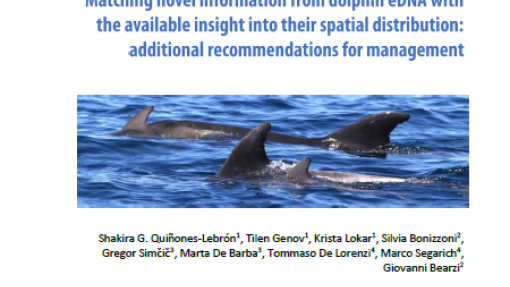
Project partners from Italy and Slovenia have completed a new deliverable focused on improving transboundary data collection on the distribution of bottlenose dolphins (Tursiops truncatus) in the northern Adriatic Sea.
One of the objectives of the SeaInsights project was to evaluate whether emerging environmental DNA (eDNA) techniques could be used as a reliable tool for assessing the spatial distribution of bottlenose dolphins. Although the eDNA data collected during WP1 activities resulted in the detection of several key species across the study area, only a few samples contained traces of dolphin DNA, limiting the method’s effectiveness for mapping dolphin distribution.
Based on these findings, the researchers concluded that visual surveys currently remain the most reliable approach for assessing bottlenose dolphin distribution in the region. At the same time, they highlighted the strong future potential of eDNA techniques as a cost-effective complementary monitoring tool capable of detecting bottlenose dolphins and their prey across large marine areas. The deliverable notes that further advances in eDNA research will be necessary before eDNA-based approaches can provide consistently robust results for operational monitoring of dolphin populations.
Based on the findings, the report presents a set of recommendations aimed at strengthening transboundary assessments of bottlenose dolphin distribution in the northern Adriatic Sea and supporting future marine conservation and management efforts.