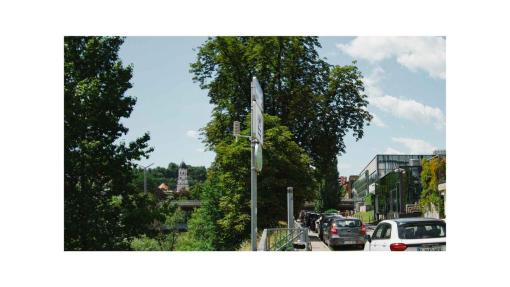
This summer, project partner Prostorož is studying Ljubljana’s heatwaves directly in the field, using sensors, questionnaires and observation sheets.
On days of extreme heat, the team records how people use the outdoor spaces surrounding Ljubljana’s healthcare institutions and compares the findings with behaviour observed on ordinary summer days. Where do patients wait? Where do staff eat? Which paths and benches empty out as temperatures rise?
Green spaces currently cover around 13% of the area, approximately half of the 25% recommended by the Ministry of the Environment and Spatial Planning. By studying patterns of use, Prostorož aims to identify where the lack of greenery is most critical—namely, the places where patients, visitors and staff are exposed to extreme heat most frequently and intensely. Particular attention is being paid to three climate shelters already established in the Ljubljana University Medical Centre area: how they are used, how much relief they actually provide and what they still lack.
To complement these observations with quantitative data, Prostorož is also measuring air temperature at eight locations across the area, including a control point in the nearest shaded park. The results clearly demonstrate the importance of greenery: between paved locations exposed to the sun and shaded green areas only a few hundred metres apart, the temperature difference can reach up to 4 °C.
Extreme heat is not only a problem in the area surrounding Ljubljana’s healthcare institutions. Despite its reputation as one of Europe’s greenest capitals, Ljubljana is experiencing a prolonged and intense heatwave, further exacerbated by the urban heat island effect. Together with the city’s residents, Prostorož is mapping public green spaces that, based on local experience, provide sufficient cooling when temperatures rise above 30 °C.
The approach draws on a recent study conducted in Bochum, a city comparable in size to Ljubljana. The survey uses a public participation geographic information system (PPGIS), a method that collects local knowledge by asking residents to mark locations directly on a map. It aims to reveal inequalities in access to green spaces that provide relief from the heat across different parts of the city.
In the photo: a temperature sensor on the Šuštarjevo Embankment in Ljubljana. Photo: Prostorož.