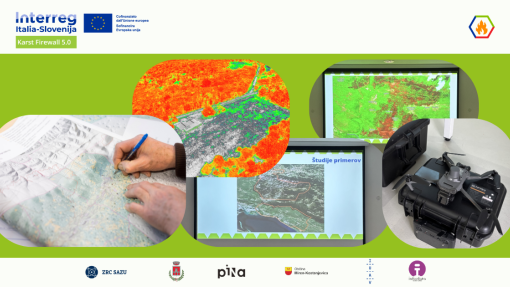
The catastrophic fires of summer 2022 on the Karst — lasting days and fought by firefighters who came from across Europe — were not an isolated incident. Since then, the Karst Firewall 5.0 project, co-financed by the European Union under the Interreg Italy-Slovenia programme, has been working on a shared tool between the two countries to prevent them: a digital platform that, every morning, shows where on the Karst fire is most likely. On 24 April, at the HEKA laboratory in Koper, the time came to put it in the hands of operators and let them try it out.
What lies behind the map
Behind the platform's interface lie thirty years of historical archives, twenty-two weather stations, data from the satellites of the European Copernicus programme, drones, sensors developed within the project, and a model that every morning divides the Karst into forty thousand cells and calculates, for each one, the probability of a fire that day. All this complexity must disappear behind an interface that frontline operators can use in a matter of seconds — perhaps from a mobile phone. This is why the project chose to have operators test it directly, rather than simply presenting it to them.
Two hours of exploration
At the HEKA laboratory in Koper — the amphitheatre behind the Bonifika Arena — around fifteen people sat down in front of their laptops: firefighters, civil protection technicians, and some Karst residents. Each logged into the platform with their own account and explored it independently. The day's risk map, zooming in on areas close to home, information layers that could be switched on and off — weather, ground stations, sensors — comparison functions, querying data from past days. Specific questions emerged: how to display a restricted area, whether station data is in real time, how to compare today with a week ago. For two hours, each participant was a user of the platform.
Four scores, four findings
At the end, participants completed a survey. To the fundamental question — would the platform help you manage fires? — the answer was unanimous: seven out of seven said yes. Three dimensions of the user experience were rated on a scale of one to five. Ease of navigation scored 4.3, a sign that the interface is accessible even to those without daily familiarity with digital tools. The clarity of the displayed data reached 4.1. System response speed was the lowest score at 3.9, pointing to an area for improvement — particularly when querying long archives. This is the first issue to address before summer.
What works and what is still needed
The survey also asked participants to rate the operational usefulness of four existing features: historical fire database, risk mapping, weather monitoring, and automatic notifications. The fire risk map came out on top, with an average of 4.7 out of 5. On the topic of features yet to be developed, the strongest request was for fire spread simulation: once a fire breaks out, knowing in which direction and at what speed the flames will move. Five out of seven participants put it at the top of their list. Predicting where a fire might start is useful — but understanding where it is heading is what saves homes, animals and lives.
The value of the test
The value of a day like this lies less in the high average scores and more in the questions raised, the small problems flagged, and the proposals for new features. A first meeting of the same kind had been held in March in Duino Aurisina, on the Italian side of the border, with a different format: there, the most at-risk areas of the Karst had been mapped together on paper; here, the platform was put directly into users' hands. Next summer, the platform will be fully operational on the Karst.