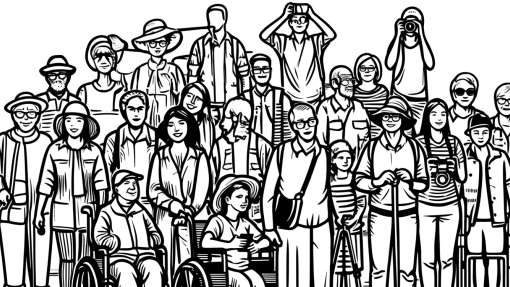
The first comprehensive cross-border report has been published as part of the DATIS project. It reveals how people with different types of disabilities experience tourism and which barriers they face in travel, accommodation, and digital accessibility. The document is based on 405 questionnaires and an analysis of 100 tourism providers, offering insight into the habits, expectations, and experiences of people who may travel differently but share the same curiosity about the world.
The research was carried out in cooperation with organisations working with blind and partially sighted people, deaf and hard-of-hearing individuals, as well as people with cognitive and mobility impairments. A large portion of the data collection took place in person, supported by intermediaries who adapted questions, clarified content, and used visual aids. This approach made it possible to include individuals who are often excluded from traditional survey methods.
Findings show that travel is very important to more than half of respondents, primarily due to its impact on wellbeing, reducing loneliness, and strengthening self-confidence. They most often choose coastal destinations, travel in small groups, and look for affordable and adapted accommodation. In public transport, respondents report frequent difficulties with unclear signage, poor lighting, physical barriers, and noisy environments that trigger sensory overload. In hotels, the most prominent obstacles are insufficient lighting, lack of tactile markings, inadequate bathrooms, and insufficiently trained staff.
Digital accessibility of tourism websites has proven to be a weak point on both sides of the border: the average accessibility score is 37% for Slovenian sites and 40% for Italian ones. The most common issues include unlabelled images, unclear navigation, and inaccessible forms. The results highlight that many destinations still do not provide the basic digital conditions that would allow all users to plan their travels independently.
The report opens an important discussion about what modern, inclusive tourism should look like. Accessibility is not an additional service but a fundamental part of hospitality that enables every traveller, regardless of ability, to experience travel independently, safely, and without barriers.
The findings will inform the preparation of a cross-border strategy to improve digital accessibility in the tourism sector. The goal of the DATIS project is clear: to create an environment in which accessible travel is not an exception, but a right fully realised in practice.
You can find more information in the attached documents. Versions are available in Italian and Slovenian.
For more updates and accessibility insights follow DATIS on social media:
Instagram: https://www.instagram.com/datis_interreg/
Facebook: https://www.facebook.com/datisinterreg
X (Twitter): https://x.com/datis_interreg