The participatory process of the SANITAS project, aimed at strengthening cooperation between the two countries to improve emergency management and ensure a more effective response from health and rescue services in the cross-border area, continues.
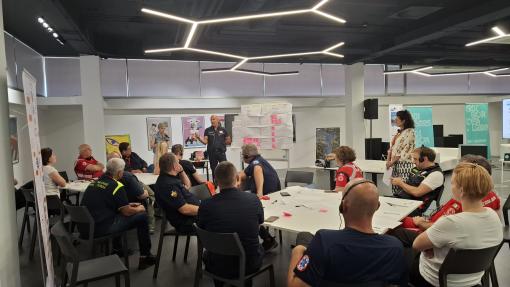
On Thursday, 18 June, the second stakeholder workshop took place at the X-Center in Nova Gorica. The meeting represented a natural continuation of the work started on 4 June at the GO! Center in Gorizia, when participants analysed the main challenges that may arise in emergency management in a cross-border context.
During the first meeting, the discussion focused on two hypothetical but realistic scenarios – a heatwave and a flood – used as a basis to identify operational, organisational, and communication obstacles that may emerge in crisis situations involving both Italian and Slovenian territories.
The second workshop shifted the focus from challenges to possible solutions. Through a participatory methodology alternating individual reflection, peer discussion, and group work, participants developed operational proposals and identified the priorities to be addressed in the coming months.
The discussion enabled the collection of a broad range of professional experience and operational knowledge gained directly in the field. This contribution is one of the key elements of the SANITAS project: the protocol is not based on a theoretical approach, but incorporates the concrete experience of those who work daily in emergency management, healthcare delivery, rescue operations, and civil protection.
Among the priority topics identified was the need to define shared procedures among the various actors involved in emergency management, in order to ensure faster, more coordinated, and more effective interventions, even in highly complex situations. Participants also highlighted the importance of strengthening communication and coordination tools between institutions and operators, fostering a common language and more harmonised operational methods.
Particular attention was also given to defining shared criteria for setting intervention priorities, clarifying the roles and responsibilities of the different stakeholders involved, and addressing the organisational and regulatory obstacles that may hinder cross-border cooperation. The discussion also emphasised the importance of developing common reference frameworks, both procedural and terminological, to facilitate cooperation between services operating in different administrative and legal systems.
The workshop was attended by representatives of ASUGI, Civil Protection of the Municipality of Nova Gorica, Red Cross Gorizia, Red Cross Palmanova, Italian Red Cross Monfalcone, GENG, NMP Ajdovščina, Municipality of Ajdovščina, General Hospital Nova Gorica, Civil Protection Service of the Municipality of Gorizia, SORES FVG, VDC Nova Gorica, Health Centre Nova Gorica, and Health Centre Tolmin.
The work carried out also contributed to a more precise definition of the stakeholders involved and the operational contexts to be considered in the next phase of the project. The collected proposals will serve as the basis for the final round table scheduled for the second half of 2026, bringing together stakeholders and competent authorities with the aim of consolidating the contributions and defining the content of the future cross-border primary healthcare protocol between Italy and Slovenia.