Second TABR Castellieri Festival – a journey into prehistory in the idyllic Karst village of Vojščica
On Saturday, 13 June, the second TABR Castellieri Festival brought life to the Karst village of Vojščica, which was also celebrating its local village feast on the same day.
The Castellieri Festival, developed within the Interreg ITA–SLO KAŠTellieri project, in which the Miren Kras Public Institute also participates as a partner, takes its name from the Tabor site, the hill overlooking the village.
Once again this year, it offered a rich programme for all generations.
“With the organisation of the second edition of the festival, we aimed to bring the heritage of prehistoric castellieri even closer to the public, both local and from other areas. This heritage is particularly rich in this region but still little known to many. It is important not only to preserve and valorise it, but also to promote it and integrate it into tourism products so that people can discover it more closely. This is precisely the objective of the KAŠTellieri project,” says Alenka Ožbot Klančič, project manager at the Miren Kras Public Institute.
The event was organised in cooperation with the local association ŠKTD Farjovca and with the support of the Local Community of Vojščica. Together, they created a narrative that transported participants back to prehistory for a day, revealing at least part of the mysteries of the castellieri.
A sporting morning among the castellieri
The rich programme of the day began already at 8:00 a.m. with a guided mountain bike tour along the Castellieri Trail, a 30-kilometre route connecting Tabor and Vojščica with the archaeological sites of Brith (Zagrajec), Martinišče (Sveto pri Komnu) and Grmača (between Kostanjevica na Krasu and Novelo).
An hour later, a hiking tour “From castellieri to castellieri” started in the village, running from Tabor to Grmača and back. Thanks to the good weather and pleasant temperatures, participants enjoyed a scenic Karst route of around 10 kilometres.
After the sports activities, attention turned to the creations produced in five thematic workshops. Under the guidance of stone mason Petra Pika Moze, participants made stone and copper amulets. In the clay modelling workshop led by visual artist Gregor Maver, they created dog figurines inspired by a bronze alloy statuette discovered in 2010 at the Kaštelir hillfort above Korte (Izola) and dated to the Late Iron Age (6th–5th century BC).
There was also strong participation in the flower crown workshop organised by the Venček Cultural and Ethnological Association from Štanjel. Flowers and other plant materials also featured in the workshop led by graphic designer Ines Gerbič Zgonc, focused on botanical printing on fabric.
Particular interest was drawn to the workshop led by archaeologist and ancient flavours specialist Polona Janežič, where participants learned about prehistoric foods and had the opportunity to taste dishes inspired by that period.
Stalls featured a wide range of handmade products, while the Farjovca association enriched the programme with social and recreational games.
Lectures and singing at Tabor
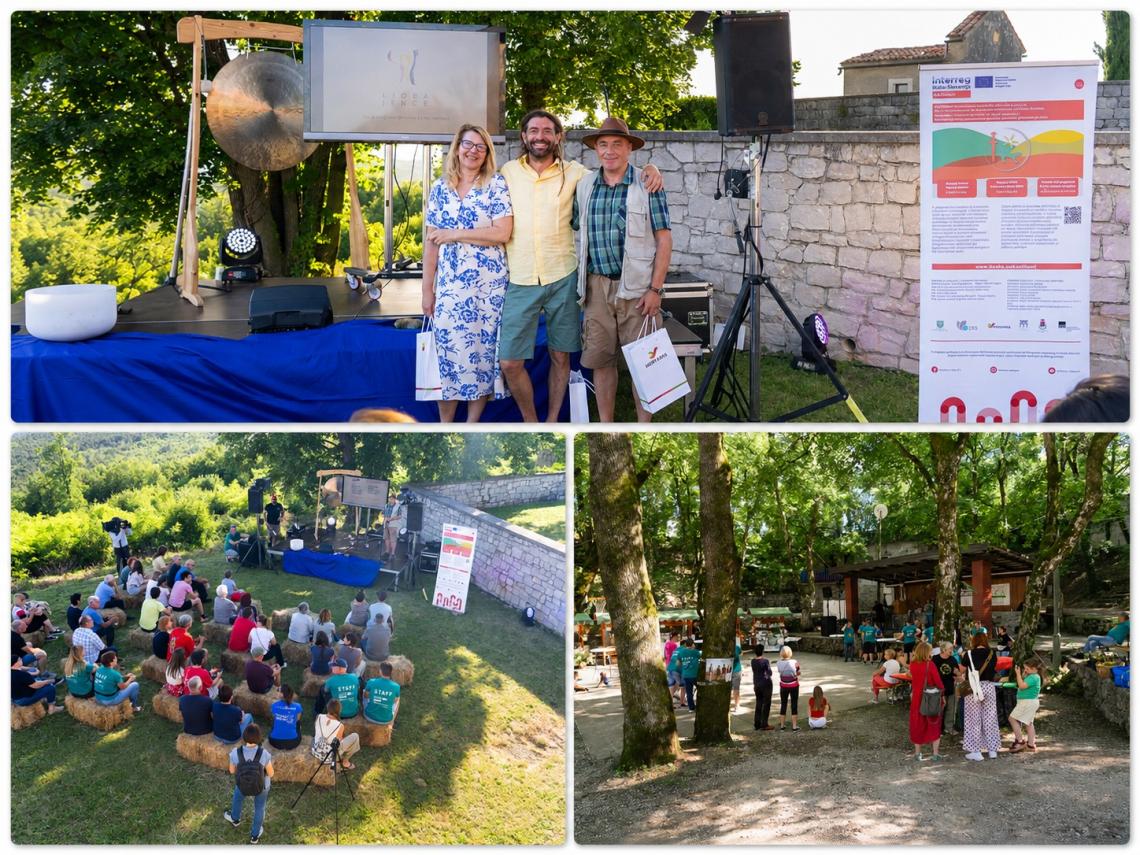
In the late afternoon, activities moved to the Tabor area near the current cemetery. After a convivial gathering with ham, cheese, wine, and a dessert inspired by the Castellieri era – baked pears with savoury herb and sheep’s ricotta with honey – participants followed a series of engaging lectures on prehistory.
Robert Lavin from the Anima Mundi Institute for Integral Development presented research findings suggesting that the castellieri of Tabor, Grmača and St. Ambrose are located on ancient geomantic structures in the landscape, often overlooked but considered important vital and energetic centres referenced by past cultures.
Maša Saccara, head of the Mediterranean Archaeology Office at the Science and Research Centre Koper (ZRS Koper), presented the characteristics of the castellieri in the Slovenian Istrian area, while Tomaž Fabec from the Centre for Preventive Archaeology of the Institute for the Protection of Cultural Heritage of Slovenia spoke about prehistoric megastructures for hunting in the Karst.
Prehistoric communities used long stone structures for collective hunting of game. These are complex dry-stone systems shaped like funnels, ranging from several hundred metres to several kilometres in length, ending in traps located beneath rock ledges or cliffs, towards which herds of wild animals were driven. This discovery is highly significant, as it represents the first identification of such hunting megastructures in Europe.
The evening featured a performance by singer Ljoba Jenče. The artist, who has dedicated her life to preserving the musical, cultural and spiritual heritage of our ancestors, created a mystical atmosphere using gongs.
The intense day concluded with an emotional concert by Klapa Škvadra at Kal, which gently led the audience into a carefree summer mood.