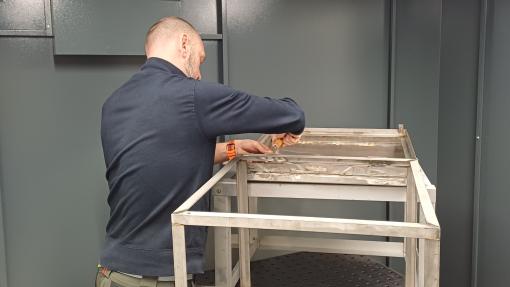
Construction is underway on the weatherproof enclosures that will house the Black Carbon (BC) monitoring instruments (Aethalometer AE33) to be deployed in the Veneto area as part of the ECOMAPS project . Designed and built in collaboration with the workshop supporting the Scientific Campus of Università Ca' Foscari Venezia, these enclosures represent a key preparatory step toward launching monitoring activities in Italy.
Custom-designed enclosures for outdoor monitoring
The enclosures are thermally insulated, water proof units designed to enable the outdoor installation of three Aethalometers supplied by Aerosol company, a project partner. These are the same instruments already in use in Ljubljana, providing continuous measurements of atmospheric Black Carbon concentrations, a pollutant associated with anthropogenic activities and climate change.
An in-house solution developed with project partners
To meet the project’s technical and operational requirements, the team opted for an ad hoc, in-house solution, commissioning construction to the technicians of the mechanical workshop at the Centro Interdipartimentale di Servizi per le Discipline Sperimentali of Università Ca’ Foscari Venezia. The enclosure design was defined in close collaboration with Aerosol d.o.o., which provided detailed specifications regarding dimensions, instrument requirements, and operating conditions.
Following the initial design phase, the first enclosure is currently being built. The units will be manufactured from polyethylene, with an internal polystyrene insulation to reduce temperature fluctuations. They will be equipped with routers to enable data transmission to external systems.
Three monitoring settings to better understand Black Carbon sources
Black Carbon measurements in the Veneto area will be carried out in three contrasting environments, selected to represent diverse environmental conditions:
- a rural area, in Meolo;
- an urban area, at the Scientific Campus of Ca’ Foscari;
- an industrial area, in Malcontenta, near an ARPAV monitoring station.
This approach will support comparative analysis of Black Carbon and its sources across the area, strengthening the quality and value of the data collected within the ECOMAPS project.