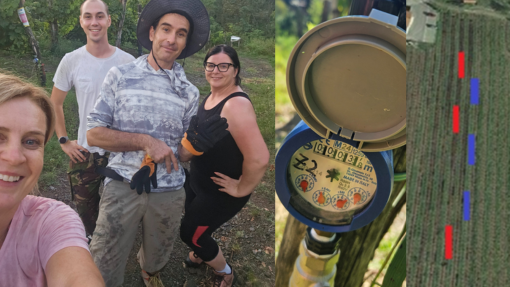
The 2025 harvest in Slovenia provides an important reference point for understanding the evolution of viticulture in the cross-border area and for assessing the outlook for the 2026 vintage with greater awareness. In the territories involved in IRRIGAVIT, the harvest once again confirmed that water and soil management have become central factors in maintaining vineyard balance and grape quality in an increasingly variable climate.
In Slovenia, the 2025 vintage was closely monitored in the project’s experimental and demonstration vineyards. In Šmarje, researchers from the Agricultural Institute of Slovenia - KIS monitored the Pinela variety through controlled deficit irrigation trials, comparing different water management strategies and assessing the vine’s physiological status, ripening dynamics and grape quality over time. The field work made it possible to collect valuable data on how vines respond to water availability and how irrigation decisions can influence the final outcome. Alongside the Pinela trials, demonstration activities in Slovenia also involved Merlot in Goriška Brda and Chardonnay in the Vipava Valley. These vineyards provided a broader view of how different varieties and pedoclimatic conditions respond to water management. Monitoring water potential, sampling grapes and analysing ripening curves confirmed the importance of timely decisions based on objective data. The 2025 harvest therefore offered a concrete opportunity to assess the role of rational irrigation not simply as an emergency measure, but as an adaptation tool. In vintages marked by alternating hot periods, dry phases and possible extreme weather events, vines may experience stress conditions that affect ripening, the balance between sugars and acidity, freshness and the aromatic profile of the grapes. For this reason, detailed knowledge of each vineyard is becoming increasingly decisive.
The picture that emerged is consistent with broader trends in European viticulture: harvests are increasingly shaped by climate variability, water availability and the ability to intervene at the right moment. The IRRIGAVIT experience shows that continuous monitoring helps interpret the plant’s response more accurately and guides agronomic choices towards greater sustainability. The data were collected in report 1.2.1.
Looking ahead to the 2026 harvest, the emerging situation strongly reflects the critical issues already highlighted last year: prolonged heatwaves, high temperatures, warm nights and increasingly long periods without rainfall are no longer exceptional events, but conditions that viticulture must face more and more often. The vine is a resilient plant and can withstand short periods of intense heat, but it struggles when drought and high temperatures combine for many consecutive days. Such stress accelerates ripening and may affect the balance, acidity and aromatic profile of the grapes. For this reason, the 2026 harvest will need to be monitored with particular care: if weather conditions remain stable, picking could begin as early as around 15 August, making vineyard monitoring, assessment of vine water status and targeted water management essential to preserve quality and production balance.