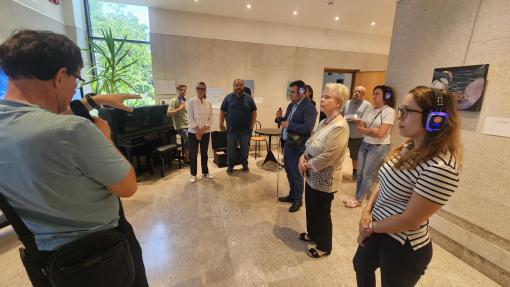
On 18 June 2026, the second public conference of the DigARegion – Digitally Accessible Region project took place at the Lojze Bratuž Cultural Centre in Gorizia, Italy. The project is co-funded by the European Union under the Interreg VI-A Italy–Slovenia Programme. The event brought together project partners (the Intermunicipal Association of the Blind and Visually Impaired of Nova Gorica, the Municipality of Nova Gorica, the Lojze Bratuž Cultural Centre, the Goriška Museum, the Society for the Conservation of the Basilica of Aquileia, and the Slovenian Organizations Council), digital accessibility experts, representatives of cultural institutions, and other stakeholders committed to creating a more inclusive society with equal access to information, services, and cultural content for everyone.
In the opening session, Tilen Škraba presented the activities and achievements of the DigARegion project. Extensive accessibility analyses of websites across the cross-border area were carried out within the project. The first automated analysis covered 2,326 websites and found that only 16 sites—less than one percent of those analysed—contained no detected accessibility errors. Slovenia accounted for 59% of the identified issues, while Italy accounted for 41%.
A second, much broader analysis examined 3,100 websites comprising nearly 177,000 web pages and identified more than 5.2 million accessibility violations. Only three websites were free of detected errors, while more than one third contained five or fewer issues. The findings confirm that 99% of websites fail even basic automated accessibility checks.
The project focused not only on identifying problems but also on developing practical solutions. General digital accessibility guidelines, as well as specialised guidelines for museums, libraries, and tourism organisations, were prepared. The partners also developed basic recommendations for improving the accessibility of physical spaces and information. A key project outcome is the dostopnovsem.org portal, which provides accessibility information, expert articles, event announcements, and guidelines in accessible HTML format. The portal will also publish the results of the automated accessibility analyses.
Education has been another major focus of the project. Ten introductory training sessions on digital accessibility have already been delivered to more than 140 participants, alongside two advanced courses for website administrators and two expert-level courses for developers. The project also operates a support centre that assists organisations in implementing accessible solutions while continuing to provide rapid accessibility reviews and other advisory services. Additional training sessions will be organised in the coming months on the Italian side of the cross-border area.
Igor Miljavec, President of the Intermunicipal Association of the Blind and Visually Impaired of Nova Gorica, presented the current state of digital accessibility in Slovenia and emphasised the importance of involving people with disabilities in the design and evaluation of accessible solutions. He stressed that legal compliance alone is insufficient if services are not genuinely usable by those who depend on them.
Participants also gained valuable insight into the everyday experiences of blind and visually impaired users through Nicolò Finocchiaro, a blind university lecturer and President of the Association of the Blind and Visually Impaired in Gorizia. He demonstrated the practical use of a screen reader and showed how blind users operate computers and access digital content, highlighting the barriers created by inaccessible websites and digital services.
The second part of the conference focused on accessibility in cultural institutions. David Kožuh presented the development of the Tactile Gallery at the Goriška Museum and showcased numerous accessibility adaptations, including tactile replicas of artworks, audio descriptions, enlarged text, and other sensory solutions that make art more accessible to blind and visually impaired visitors.
The conference concluded with a presentation by the Lojze Bratuž Cultural Centre on its efforts to improve the accessibility of gallery content through the use of Braille, adapted information systems, and digital tools for viewing and enlarging works of art.
The event once again demonstrated that accessibility is not merely a legal requirement but an essential step towards building a more inclusive society in which everyone can enjoy equal access to information, services, and cultural content.