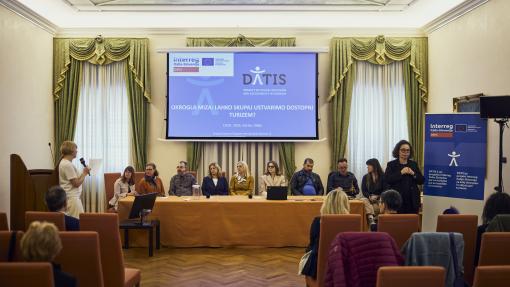
On Tuesday, 19 May 2026, the final event of the DATIS project – Digital Pioneers of Accessible Tourism – entitled Accessible Tourism Begins with Accessible Information, took place at the Grand Hotel Entourage in Gorizia, Italy. The event brought together project partners, representatives of organisations of persons with disabilities, researchers, tourism organisations, accessibility experts, users and other stakeholders in the field of inclusive tourism from Slovenia and Italy. Its aim was to present the key results of the DATIS project and open a discussion on how digital, physical and communicational accessibility can jointly contribute to the development of tourism for all.
The DATIS project is based on the understanding that the tourism experience does not begin only upon arrival at a destination, but already with the first piece of information. For persons with disabilities, older persons and other users with different impairments and needs, the accessibility of websites, images, texts, forms, maps, booking systems and other contact information is often crucial in determining whether they can plan a visit independently at all, let alone carry it out independently.
Accessibility as a long-term process of cooperation
In the opening part of the event, the speakers emphasised that accessibility in tourism is not a one-off measure, but a long-term process requiring cooperation between different stakeholders.
Mario Brancati, President of the Regional Consultative Body of Associations of Persons with Disabilities and Their Families of Friuli Venezia Giulia, underlined the importance of cooperation between organisations of persons with disabilities, tourism providers, public institutions and local communities. Accessibility in tourism is established gradually, through persistent work, cooperation and the understanding that it must become part of the broader development of destinations, rather than merely an individual project activity.
Štefan Kušar, Secretary of the Slovenian Association of the Blind and Partially Sighted, highlighted the importance of the continuous involvement of persons with disabilities in the planning of accessible solutions. He stressed that users must be included already in the process of identifying barriers, analysing accessibility and preparing appropriate solutions.
Luca Fontana, President of the association of social cooperatives Il Mosaico, drew attention to the importance of involving users, especially persons with cognitive impairments, in the development of accessible tourism solutions. He emphasised that accessibility is not only a matter of technical adaptations, but also of clear communication, understandable information, a supportive environment and direct cooperation with the people who actually use the services.
Special attention in the opening part was also given to persons with disabilities living in border areas. In addition to the general lack of accessible information, they may face additional barriers such as bilingualism, different support systems, different social arrangements and limited availability of adapted activities.
Presentation of the key project results
The main part of the event presented the key results of the DATIS project, including research on the needs and experiences of persons with disabilities in tourism, pilot activities at the museum on Debela griža / Monte San Michele and in the Municipality of Ajdovščina, the analysis of the digital accessibility of 100 tourism websites from Slovenia and Italy, the DATIS web database, and the guidelines and strategy for more accessible tourism communication.
Professor Moreno Zago from the University of Trieste presented the findings of the research on users’ habits and experiences. The research showed that tourism is important for persons with disabilities not only as a leisure activity, but also as a space for social inclusion, independence, well-being and equal participation in society. At the same time, the research showed that users often lack clear, reliable and accessible information when planning trips.
Luca Bianchi, an expert in the evaluation of social and health policies from Quolity srl, presented the results of the pilot activities in San Michele and Ajdovščina. The pilot activities demonstrated how important it is to test accessible solutions in practice, together with users and organisations that know their needs well. Such testing makes it possible to identify concrete barriers that formal reviews alone often cannot fully detect.
Digital, physical and communicational accessibility
One of the key messages of the event was that accessible tourism cannot be understood only as a question of the physical accessibility of space. For a truly inclusive tourism experience, three levels of accessibility must be connected: digital, physical and communicational accessibility.
Michele Franz from CRIBA – the Regional Centre for Information and Housing without Barriers – presented the importance of the physical accessibility of tourism providers and stressed that reliable data on the actual accessibility of spaces, routes, services and infrastructure is essential for the development of accessible tourism. Physical accessibility is one of the foundations of an accessible experience, but it must be connected with accessible information and appropriate communication.
Maša Malovrh, digital accessibility expert from Beletrina, presented the results of the analysis of the digital accessibility of 100 tourism websites. The analysis showed that tourism websites in the cross-border area are often visually modern and technically solid, but still do not enable equal use for all users. The average level of digital accessibility of the analysed websites was 37% for Slovenian tourism providers and 40% for Italian tourism providers. The most common problems were related to missing or inadequate image descriptions, videos without captions, insufficient colour contrast, lack of navigation aids, difficulties in using websites with a keyboard, and inaccessible forms and search tools.
Special attention was also given to the DATIS web database, which presents in one place the level of accessibility of tourism providers’ websites in the cross-border area of Slovenia and Italy. As Malovrh emphasised, the database helps users check, even before visiting a provider’s website, whether they are likely to be able to find information independently, make a reservation or contact the provider. At the same time, it shows tourism providers which information they need to present in a clear, accessible and useful way.
Round table: Co-creating accessible tourism
The central part of the event was the round table entitled Co-creating Accessible Tourism: Can We Do It Together?, which brought together users, user organisations, researchers, tourism organisations and project partners.
The discussion focused on practical experiences from the pilot activities at the First World War Museum on Debela griža / Monte San Michele and the Industrial Heritage exhibition in Ajdovščina, on findings from interviews with users and organisers of tourism activities, and on the question of how cooperation between different stakeholders can contribute to the long-term development of accessible tourism.
Members of Il Mosaico, Claudia Zandomeni and Riccardo Urban, spoke about their experience of the pilot activity at the multimedia museum on Debela griža / Monte San Michele. They emphasised that tourism information must be clear, understandable and adapted to users with different needs. They described the visit as a positive experience, as they felt relaxed, comfortable and safe during the exhibition. A sense of acceptance, clear presentation of content and the possibility of calm participation are important conditions for persons with cognitive impairments. The participants assessed the experience as good and said they would recommend the visit to others.
Members of ZDSSS, Gaja Beč and Boštjan Vogrinčič, spoke about their experience of the pilot activity in Ajdovščina and emphasised the importance of information that is useful for blind and partially sighted visitors. Important elements include quality descriptions, a clear structure of information, the possibility of independent orientation, good communication before the visit and the inclusion of users in testing solutions. At the same time, they pointed out that there were still many physical barriers during the visit, and that the online content related to the exhibition was not sufficiently accessible. The pilot activity therefore clearly showed how important it is for physical, digital and communicational accessibility to be developed together.
In the discussion, representatives of tourism organisations emphasised that accessibility in tourism is an important development issue, but that in practice they often face very concrete limitations. Alessia Del Bianco from PromoTurismo FVG and mag. Erika Lojk, Director of the Public Institute for Tourism Nova Gorica and Vipava Valley, highlighted that tourism organisations and providers need appropriate staff, professional support, clear guidelines and external expertise in order to work systematically on accessibility. A lack of staff, time, specialised knowledge or external support can sometimes prevent or slow down activities related to accessibility, even when there is awareness that such activities are necessary.
This is why the results of projects such as DATIS are important: they can support providers and destinations with practical tools, concrete recommendations, verified information and links with user organisations.
Accessibility must therefore become part of the regular development of tourism services, rather than an additional task dependent only on an individual project or a single employee. The participants agreed that accessible solutions must not be designed without users. Their experiences are essential for understanding real barriers, which technical reviews or formal standards alone cannot always fully capture. It is important that users are included already in the planning, testing and evaluation of tourism information, services and experiences.