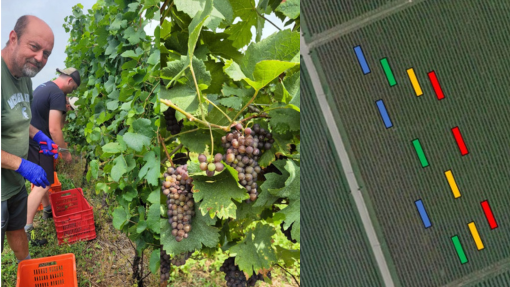
In 2025, harvesting in the experimental vineyards of the IRRIGAVIT project, which focuses on the sustainable management of irrigation and soil in viticulture, began at the end of August in the trial sites located in Italy and Slovenia.In Beano di Codroipo, at the Pantianicco estate, researchers from the Department of Agricultural, Food, Environmental and Animal Sciences of the University of Udine (DI4A Uniud) worked alongside colleagues from the Slovenian partner Kmetijski inštitut Slovenije (KIS) during the Pinot grigio grape harvest. Over two seasons, the vineyard hosted a comparison of different deficit irrigation strategies. The activities included monitoring the water status of the vines and calibrating the DSS decision-support system on the basis of predawn leaf water potential (Ψpd). The trial compared a well-watered condition (WW), a mild deficit strategy (Def 1), a mild-to-moderate deficit strategy (Def 2) and a moderate deficit strategy (Def 3). This progressive comparison made it possible to assess the effects of reduced irrigation inputs on vine physiology, grape ripening and the main production parameters.
At the same estate, a demonstration trial was also carried out on Glera, following the same experimental design used for Pinot grigio. During the summer season, vine water potential and ripening trends were monitored through regular grape sampling. At harvest, production parameters were assessed and experimental microvinifications were started, providing material for the subsequent sensory evaluation of the wines obtained.
Overall, two experimental trials focusing on irrigation and two on soil management were carried out in Italy, with the aim of strengthening the protocols proposed by the project. Similar activities were also conducted in Slovenia, as part of a shared cross-border pathway among the project partners.
The final goal of IRRIGAVIT is to integrate the results collected with the knowledge already developed within the previous Interreg V-A Italy-Slovenia project “Acquavitis”, in order to define new guidelines for irrigation and soil management in vineyards across the cross-border area. These guidelines will support winegrowers in adopting more efficient and sustainable strategies, particularly in an increasingly variable climate context.
Monitoring continues in 2026
Monitoring activities will continue in 2026, in a season marked by particularly high temperatures, with values close to 40 degrees. In Friuli Venezia Giulia, current weather conditions and the onset of veraison may lead to an earlier harvest, although the actual timing will depend on meteorological developments in the coming weeks. In this scenario, monitoring vine water status and assessing plant responses remain essential tools for supporting agronomic decisions in the field. Against this background, local winegrowers are preparing for a demanding season, in which water and soil management will continue to play a central role in preserving vineyard quality, productive balance and resilience.