High-Protein Spreadable Cheese and Probiotic Yogurt: Tangible Results from Applied Research
As part of the experimentation on valorizing dairy by-products, the DAIRY+ project has led to the development of two new products: a spreadable cheese enriched with protein concentrate extracted from whey, and a probiotic yogurt. Both products will now be offered to dairies in Friuli Venezia Giulia, Veneto, and Slovenia as opportunities to enhance business profitability through circular economy practices.
From Research to Market: High-Value Innovative Products
These two innovative foods mark a significant milestone for the project co-financed by the European Union under the Interreg VI-A Italy-Slovenia Programme. The initiative involves the Soča Valley Development Centre, Fondazione Agrifood & Bioeconomy FVG, the Department of Food, Environmental and Animal Sciences (DI4A) at the University of Udine, the Faculty of Biotechnology at the University of Ljubljana, and the Istituto Zooprofilattico Sperimentale delle Venezie.
DAIRY+ aims to show small and medium-sized dairies how to recover and reuse their by-products (the most abundant of which is whey) through circular practices that are both more sustainable and profitable. This approach allows companies to expand their commercial offerings with high-value products capable of targeting growing market segments, such as those for athletes and vegetarian consumers.
Training the Professionals of Tomorrow: Strategic Co-Design Workshop with Italian and Slovenian Students
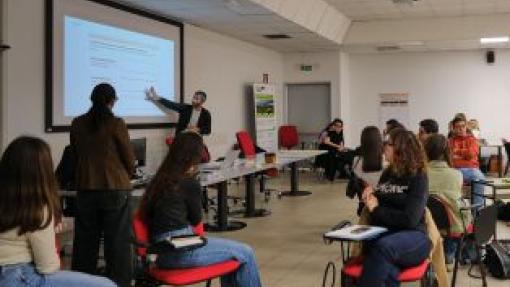
The project also aims to pass this knowledge on to the entrepreneurs and professionals of the future. Fondazione Agrifood FVG established an interactive co-design workshop involving students from the Bachelor’s Degree in Food Science and Culture at the University of Udine and the Food Science program at the University of Ljubljana.
Students were guided through a structured theoretical and practical program aimed not only at creating digital communication materials but also at developing a comprehensive communication strategy to effectively position the innovative products with the target dairies.
The workshop was divided into three phases:
1. Theoretical foundations (4 March 2026)
An online group session on communication and technology theory, to provide students with the necessary conceptual foundations.
2. Strategic co-design (13 March 2026))
A practical and creative in-person session in Udine, where Italian and Slovenian students worked together using the ‘World Café’ method, a facilitation technique that encourages creative collaboration through structured conversations.
The students, divided into groups, developed a communication strategy based on five key areas:
● WHO – Understanding the real audience
From generic audiences to actual dairy professionals: who are the real recipients of the communication? What are their operational realities, economic constraints and decision-making processes?
● WHAT – Clarifying the real opportunity
From ‘waste’ to ‘valuable resources’: how can we clearly explain what dairy by-products are and how they can generate economic, environmental and operational value?
● WHEN – Identifying the right moments
From abstract information to decision-based communication: when are industry professionals most receptive? When do they make operational, investment or regulatory decisions related to by-product management?
● WHERE – Reaching professionals in the right places
From general outreach to sector-specific environments: through which channels, networks and professional environments does information actually circulate amongst dairy professionals?
● WHY – Connecting valorisation to the future of the sector
From a technical issue to a strategic transition: how can we link the valorisation of whey to the sector’s broader challenges, such as the circular economy, sustainability and long-term competitiveness?
For each dimension, the groups analysed:
● What obstacles, constraints or risks might prevent the scenario from being realised
● What would need to change to overcome these obstacles
● What this all means for communication: tone, language, messages, narratives
3. Conclusion (1 April 2026)
Closing webinar to present and discuss the promotional material produced collaboratively.
The workshop encouraged participants to:
● Develop skills in communicating technological complexity
● Co-create content through an experimental and strategic approach
● Actively contribute to the project’s narrative
Investing in young people to build the sector’s future
"Our concrete, day-to-day commitment is to help raise young people’s awareness of current and important issues, such as sustainable innovation, the circular economy and the communication of technology,” commented Pier Giorgio Sturlese, president of the Agrifood & Bioeconomy FVG Foundation. “Young people are the professionals and entrepreneurs of tomorrow: investing specifically in their training means laying the foundations for a more competitive and sustainable future for our region.”