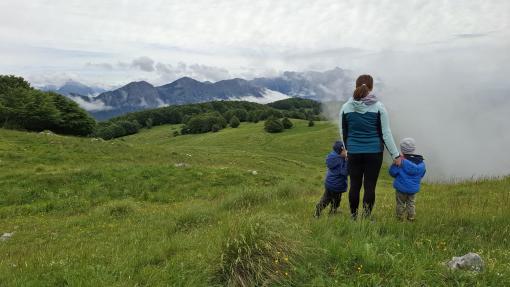
On Saturday, 6 June 2026, colleagues from Posoški razvojni center, visited Pašna skupnost Bošca as part of the ITINERANT project. The visit took place in the Kobariški Stol area, on Planina Bošca.
The visit was part of project activity D.2.1.5 – Revitalisation of pastures. This ITINERANT activity supports the sustainable use of agricultural land. In Bošca, this support has taken the concrete form of pasture equipment. It also contributes to the conservation of valuable habitats of protected bird species and the landscape, as well as to the development of low-impact tourism that respects nature and local land use.
From the first hours of the morning, Bošca showed us why this action matters. Pastures, protected trees shaped by the wind, livestock, natural watering ponds, cheesemaking knowledge and the work of herders are not separate stories here. Together, they form a landscape that remains open, species-rich and alive because people still use it and maintain it in line with its own conditions and limits.
Planina Bošca, as mountain pastures once were
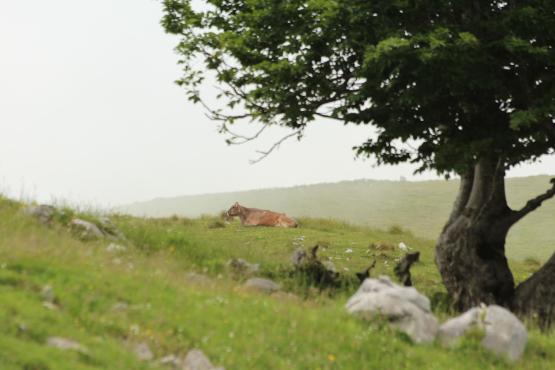
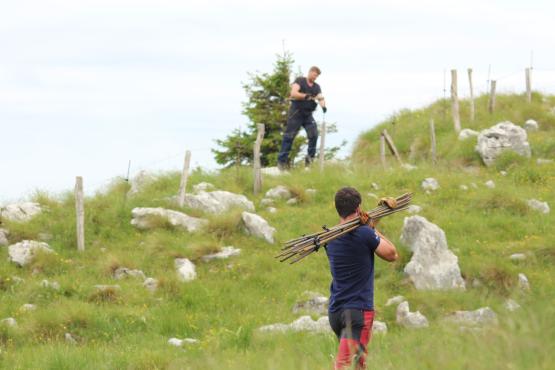
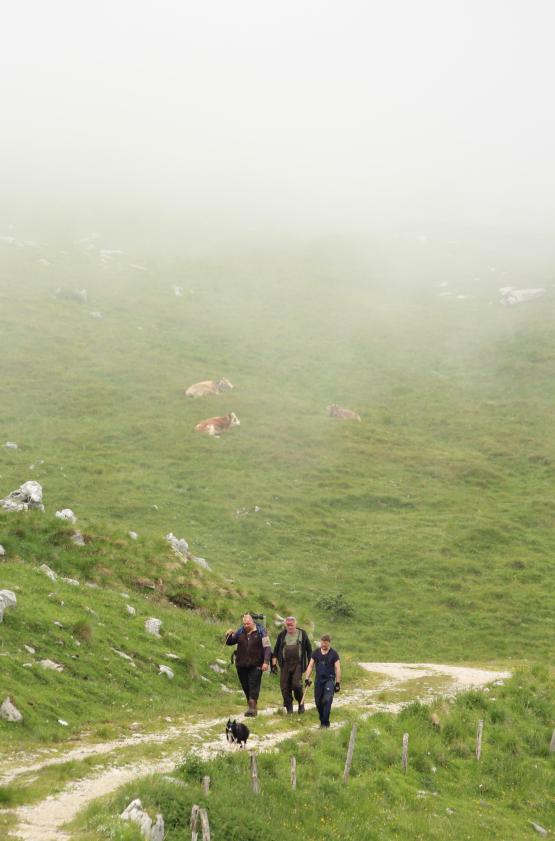
We arrived at Planina Bošca in the morning. Light mist was moving above the pastures, while the cows calmly chewed their morning feed. The herders were already preparing everything needed to set up the electric fencing. A lively herding dog followed the work closely.
We were positively struck by the commitment and hard work of the grazing community. The herders and other members of the community keep alive something that is increasingly rare today: cooperation, solidarity and mutual help. Above all, they show deep affection for the natural landscape, the peace of the mountain pasture and their animals.
Together with Katarina Rutar, a member of Pašna skupnost Bošca, we visited the pastures and the mountain dairy facilities. There, under the careful eye of cheesemaker and president of Pašna skupnost Bošca, Blaž Kravanja, the first cheese and fresh curd cheese of the season were already being prepared.
Planina Bošca is distinctive among the mountain pastures of the Posočje area. While many other mountain pastures produce cheese mainly from goat’s or sheep’s milk, cheese on Bošca is made mostly from cow’s milk, with some goat’s milk added. The whole production process takes place on the mountain pasture: from milk production to processing into cheese, fresh curd cheese and whey.
How ITINERANT supports pasture revitalisation
Under activity D.2.1.5, Pašna skupnost Bošca received equipment for pasture management and use. The equipment includes water troughs, an electric fencing unit, wire, insulators and metal posts. This equipment is essential on the ground. It helps guide livestock safely, makes the herders’ work easier and supports better maintenance of grazing areas.
In a demanding mountain area, these measures are very concrete. Without water, fences and basic infrastructure, grazing becomes more difficult. When grazing is abandoned, open areas can quickly become overgrown.
Pasture revitalisation is therefore not merely the purchase of equipment. It is a contribution to the continuation of a traditional use of the landscape, one that maintains grassland habitats and local knowledge.
Natural watering ponds and livestock water supply
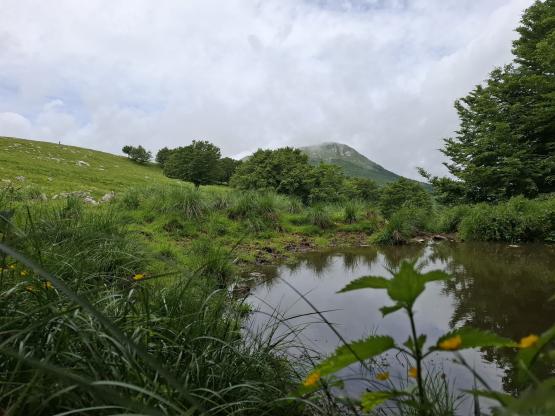
Water is one of the key conditions for grazing on Bošca. The pastures also contain natural watering ponds, locally known as kali, which are an important part of the mosaic landscape.
These ponds are valuable for the survival of cattle on the mountain pasture. At the same time, they form part of the area’s natural and landscape diversity. For livestock watering, the natural ponds are complemented by water troughs. Some of these troughs were purchased through the ITINERANT project.
This combination preserves existing natural features while supporting a more reliable water supply for the animals.
Grazing maintains biodiversity-rich grasslands
We walked through pastures filled with thousands of flowering grassland plants. At first sight, it was clear that we were in a species-rich area.
Mountain pastures are not important only for agriculture. They also matter for pollinators, birds, plant diversity and the recognisable character of the Alpine cultural landscape.
When grazing is abandoned, pastures begin to close. The landscape changes, grassland habitats are lost, plant diversity decreases and knowledge built over generations disappears.
This is also why mountain pastures and grasslands are important in the wider European framework. Regulation (EU) 2024/1991 on nature restoration emphasises the restoration of ecosystems, habitats and species. The EU Biodiversity Strategy for 2030 sets the framework for protecting nature and restoring degraded ecosystems.
For areas where grasslands, birds, grazing and visitors meet, the Birds Directive and the Habitats Directive are also relevant.
There is no way forward without local and traditional knowledge
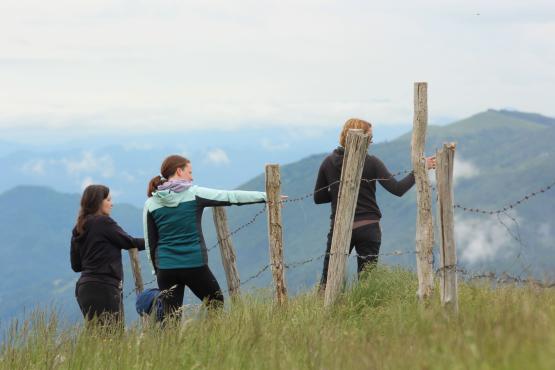
Part of the visit was dedicated to conversations with members of Pašna skupnost Bošca. We spoke about the past and future of the mountain pasture, water, overgrowth, access, maintenance of buildings and tourism.
These conversations are important for the continuation of the ITINERANT project. Measures for mountain pastures cannot be designed only on paper. They must start from the knowledge and needs of the people who work on the ground every day.
Members of the grazing community know the local conditions, grazing areas, livestock behaviour, access roads and limits of the space better than anyone else. Local knowledge is therefore the basis for measures that can actually be implemented.
This is also consistent with the direction of ITINERANT. The project develops sustainable tourism in the cross-border area of the MAB UNESCO Julian Alps Biosphere Reserve by connecting natural and cultural heritage, local communities, quality of life for residents and the conservation of fragile habitats.
More information is available on the official ITINERANT project page
Tourism must support grazing, not put pressure on it
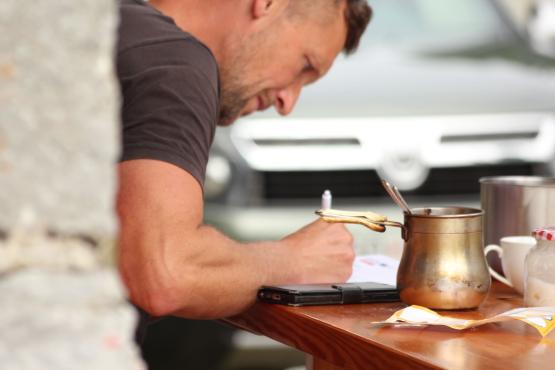
From the upper part of Planina Bošca, the view opened in all directions: towards the sea, the Nadiža/Natisone valley with Breginjski kot, Kobarid, Tolmin and Skutnik. With such views, it is easy to understand why the area is so attractive to visitors.
But Bošca is first of all a grazing landscape. It is not a tourism playground.
As we were leaving in the afternoon, the forest road was already filling with cyclists, vans with foreign licence plates and paragliders. This is not a criticism of individual visitors. It is a warning that the area needs timely guidance and visitor regulation.
If we want Bošca to remain well preserved, access and infrastructure for farmers will need to be improved. Visitors will also need clearer and more controlled guidance.
Tourism in this area must support local farmers, herders and nature conservation.
This direction is also consistent with European tourism guidelines. The EU Transition Pathway for Tourism emphasises the green transition, destination resilience and cooperation with stakeholders. The Interreg VI-A Italy-Slovenia Programme 2021–2027 supports cross-border cooperation that protects natural and cultural heritage and improves quality of life in the programme area.
A small action with long-term meaning
The revitalisation of pastures on Bošca is a concrete action on the ground. At the same time, it raises a broader question about the future of mountain areas.
Who will care for them? How will access be managed? How many visitors can they carry? How can tourism help instead of creating additional pressure?
The shared wish of everyone who was on Bošca that day is that this area remains a grazing landscape, open and rich in species. That flowering grasslands, natural watering ponds, cheesemaking knowledge, pastures with livestock and the work of the people who care for the mountain pasture all remain part of its future.
The ITINERANT project – With sustainable tourism towards a better quality of life in the Julian Alps Biosphere Reserve area – is co-financed by the Interreg VI-A Italy-Slovenia Programme 2021–2027 through the European Regional Development Fund.
On Bošca, the project supports the sustainable use of pastures, landscape conservation and tourism development based on local needs and respect for the area’s natural and cultural heritage.
Photos © Jerica Kobal, 2026, and © Maja Vrčon, 2026 (photos: mother with child; natural pond)
Related content
Regulation (EU) 2024/1991 on nature restoration
EU Biodiversity Strategy for 2030
Slovenia’s CAP Strategic Plan 2023–2027