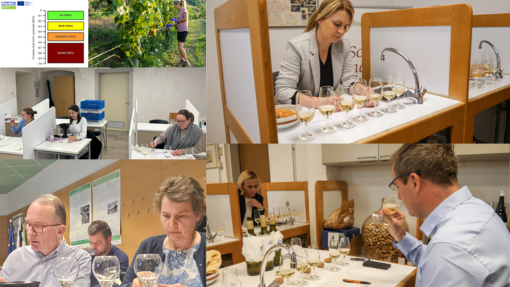
In 2025, the IRRIGAVIT project strengthened its sensory analysis activities in Slovenia through a programme dedicated to experimental wines produced from the native Pinela variety. The tastings, coordinated by the Agricultural Institute of Slovenia (KIS), combined training, applied research and technical exchange, contributing to the assessment of the effects of different irrigation regimes on the quality of wines produced in cross-border trials.
The first training activities took place on 8 January 2025 as part of the lectures at the School of Viticulture and Enology of the University of Nova Gorica, with four female students involved as a focus group in an introductory session on sensory analysis methods led by Dr Klemen Lisjak, and on 5 February 2025 at KGZS Novo Mesto, where 17 winegrowers and wine producers not specifically trained in sensory analysis took part in a four-hour training workshop led by researcher Andreja Vanzo. The wines tasted, from the 2024 vintage, were microvinified from grapes subjected to three different irrigation regimes: regular irrigation, moderate water stress and severe water stress. Participants were able to deepen their understanding of the principles of wine sensory analysis and apply evaluation methods useful for understanding the link between water management in the vineyard and the organoleptic characteristics of the final product. The training contributed to the transfer of knowledge to new wine-growing areas.
The programme continued with the second Slovenian tasting, divided into three technical sessions held on 20 and 27 March and 2 April 2025 at KIS in Ljubljana, designed to collect data for the research that was subsequently processed. The internal panel consisted of eleven participants, including producers and representatives of the wine sector (Barbi Vrčon Močivnik (Revija Vino), Damjan Štokelj (Vina Štokelj), Bandel Gregor (B&B d.o.o.)) as well as staff and researchers from the Agricultural Institute of Slovenia (Anastazija Jež Krebelj, Andreja Vanzo, Dejan Bavčar, Franc Čuš, Katja Šuklje, Klemen Lisjak, Nicola Paolinelli (KIS)) and the University of Ljubljana (Tatjana Košmerl).
The organisation was handled by Nicola Paolinelli, under the supervision of researchers Andreja Vanzo and Klemen Lisjak. The panel was provided with a sensory evaluation sheet, and on each tasting day three samples of 2024 Pinela (still wine) from the experimental vineyard in Šmarje, in the Vipava Valley, were tasted. Three water-management strategies were tested there: irrigated control, moderate water deficit and severe water deficit. The deficit levels were defined according to the water status of the plants, following the indications of the DSS Vintel system, adopted within the project for precision viticulture. The accuracy of the Vintel model was verified through measurements of pre-dawn water potential. The sensory data collected were processed and compared with laboratory analyses and integrated into the project’s final report, contributing to the definition of the IRRIGAVIT guidelines for more rational irrigation management in vineyards.